
Don't Replace Tally or Zoho Books. Fix the Work Happening Around Them
By FynHelp Team, Editorial
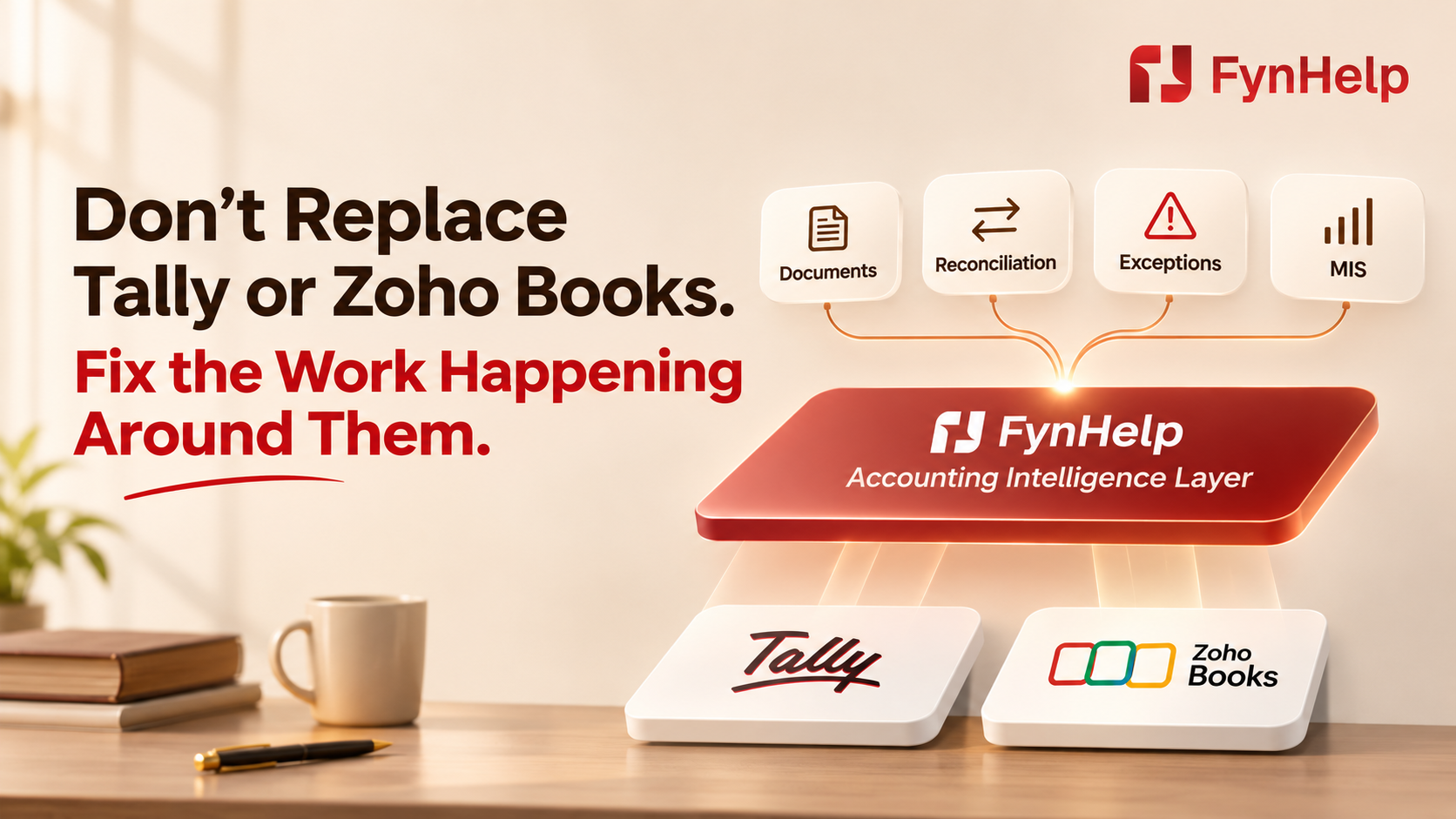
An accounting intelligence layer is software that works above existing accounting systems such as Tally and Zoho Books. It extracts data from bank statements, invoices, and GST documents, reconciles it against the books, and surfaces exceptions for review, so a firm can improve reconciliation without migrating its ledger.
Your accounting software may not be the bottleneck.
The hours spent getting documents, bank data, and GST records to agree might be.
When reconciliation drags, the instinct is often to look for a new accounting platform. But accounting systems exist to maintain books, record transactions, and produce reports. Most of the slow work happens around them: collecting documents, reading statements, matching payments to invoices, and explaining why figures do not agree.
Before replacing a system, it is worth asking which part of the work is actually slow.
Why Is Another Accounting System Often the Wrong Answer?
Short Answer
A new accounting platform may not remove the manual work, because that work sits around the ledger rather than inside it. Moving clients to new software can relocate the same steps to a new screen.
Practical Example
A firm moves 25 clients to a new platform. Bank statements still arrive as PDFs, payments still settle multiple invoices, and GST differences still need investigation. The ledger is new, but the matching work is unchanged.
Key Takeaway
A new ledger changes where entries live, not how documents get matched to them.
What Does Migration Really Cost a CA Firm?
Short Answer
Migration costs show up in data movement, staff retraining, client persuasion, and running parallel processes during the changeover.
Cost
Why It Matters
Data migration
Historical records must be moved and checked
Retraining
Staff relearn workflows on the new system
Client adoption
Many clients have already chosen their own software
Parallel running
Two processes run side by side during transition
None of this means current tools are failing.
Key Takeaway
Migration is a large, certain cost aimed at a problem that may sit elsewhere.
Where Is the Gap Between Documents and the Ledger?
Short Answer
The gap is the work before and around ledger entries: gathering documents, interpreting statements, matching payments to invoices, and checking GST differences. It is spread across spreadsheets, email threads, folders, and the memory of experienced staff.
Practical Example
A payment appears under a shortened vendor name. One receipt settles several invoices. A scanned statement has to be read before its entries can be compared. The ledger is in place and the work is still slow.
Key Takeaway
A well-maintained ledger can sit beside a fully manual reconciliation process.
What Is an Accounting Intelligence Layer?
Short Answer
An intelligence layer works above the accounting systems a firm already uses. It extracts information from documents, reconciles it against the books, separates clean matches from exceptions, and produces outputs that trace back to source.
Bank Statements + Invoices + GST Documents → Extraction → Reconciliation → Exceptions → Review
Key Takeaway
The layer handles the work around the books while the books stay where they are.
Accounting Software vs an Intelligence Layer
Short Answer
Accounting software maintains the books. An intelligence layer extracts documents, reconciles records, and surfaces exceptions around them.
Accounting Software
Intelligence Layer
Records transactions
Extracts data from bank statements, invoices, and GST documents
Maintains the ledger
Reconciles books against bank and GST data
Produces reports
Surfaces exceptions for human review
Holds the firm's entries
Produces MIS and narration packs traceable to source
Needs migration if replaced
Works alongside existing systems
Key Takeaway
The two do different jobs, so the question is rarely which one to pick.
What Questions Should You Ask Before Choosing a Tool?
Short Answer
Judge reconciliation tools on operational fit rather than a long list of features.
Question
Why It Matters
Does it work with systems your clients already use?
Avoids forcing clients to switch
Can reviewers trace an output to its source document?
Makes review evidence-led
Does it make exceptions visible or create another queue?
Reduces work instead of relocating it
How does it handle scanned statements and irregular narrations?
Real data is rarely clean
Does the firm keep control of ledger entries?
Preserves accountability
Is pricing practical as client entities grow?
Cost should scale sensibly
Key Takeaway
Six operational questions filter better than sixty features.
How Should You Test a Tool on Your Own Clients?
Short Answer
Choose a representative set of clients and include the difficult ones. Difficult clients are where workflow differences become visible.
Practical Example
A firm picks eight clients for a trial: three with clean exports, three with scanned statements, and two with heavy multi-invoice payments. Comparing the current process with the proposed one on all eight shows how each handles messy data, not just clean data.
Key Takeaway
A trial built only on clean clients proves very little.
How Should You Measure the Improvement?
Short Answer
Compare the current workflow with the proposed one and track the manual work that disappears, not just the software added.
Time spent collecting and preparing documents
Number of manual matches
Exceptions requiring investigation
Review cycles per client
Effort needed to explain a figure to the client
Key Takeaway
Success is measured in manual work removed, not tools adopted.
How Does Ledger Control Stay With the Firm?
Short Answer
An intelligence layer organises evidence and surfaces exceptions, while the firm's team posts entries and performs final review. Keeping posting with people preserves professional accountability.
Layer Surfaces Exceptions → Team Decides → Team Posts to Ledger
Key Takeaway
Software prepares the evidence, but accountability for the books stays with the firm.
How FynHelp Fits Alongside Tally and Zoho Books
FynHelp is designed as an intelligence layer above the accounting systems a firm already uses.
Information from bank statements, invoices, and GST documents is extracted and reconciled against the books. Straightforward matches are separated from exceptions that need human review, and MIS and narration outputs can be traced back to source documents.
This approach fits around Tally and Zoho Books rather than requiring a ledger migration. FynHelp does not write to the ledger. The firm's team keeps control of entries and final review.
Book a Demo
To see how FynHelp works alongside Tally and Zoho Books to support reconciliation and review, book a demo at fynhelp.com.
Conclusion
Accounting software and an intelligence layer solve different problems.
If the ledger is sound and the slow part is the work around it, replacing the software spends a lot of effort for little relief. Fixing the document-to-ledger work directly is often the more practical route.
Existing Ledger → Intelligence Layer → Exceptions → Human Review → Firm Posts
Test on your hardest clients, ask operational questions, and measure the manual work that disappears.
Frequently Asked Questions
Do I need to replace Tally or Zoho Books to automate reconciliation?
No. An intelligence layer works above existing accounting systems, so a ledger migration is not required.
What is an accounting intelligence layer?
It is software that sits above accounting systems to extract documents, reconcile records, and surface exceptions for review, while the ledger stays where it is.
Does FynHelp post entries to the ledger?
No. FynHelp does not write to the ledger. The firm's team controls entries and final review.
What should I check before choosing a reconciliation tool?
Check client-system compatibility, source traceability, exception visibility, handling of scanned statements, ledger control, and how pricing scales with client entities.
How do I test a tool fairly?
Use a representative set of clients, include difficult ones, and compare time, manual matches, exceptions, and review cycles against your current process.
Keep reading
- Junior Accountants Should Learn Judgement, Not Spend Years as Matching MachinesReconciliation · 7 min read
- GST Mismatches, Unidentified Credits and Missing Invoices, Stop Letting Exceptions Hide in SpreadsheetsReconciliation · 8 min read
- Every Month-End, Your CA Team Loses Days to ReconciliationReconciliation · 10 min read
How FynHelp helps
FynHelp runs a CA firm's month-end close in four steps: bank statement and Tally export extraction, bank reconciliation, source-traceable MIS reports and automated document follow-ups. See pricing for CA firms.
FynHelp reads statements and Tally exports, matches bank to books and drafts the MIS. Free to start, no card needed.
Start free trial