
Junior Accountants Should Learn Judgement, Not Spend Years as Matching Machines
By FynHelp Team, Editorial
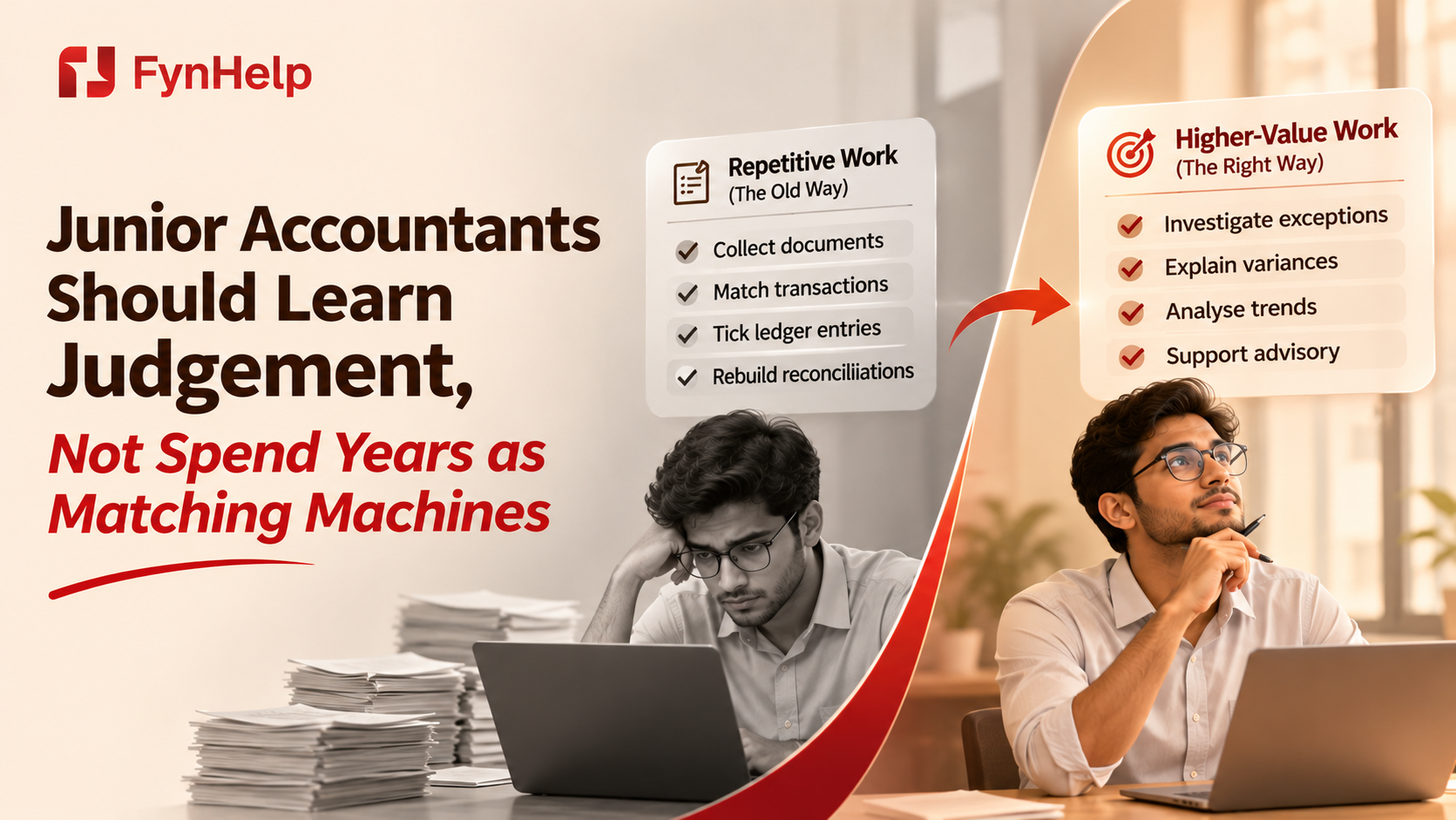
Automation can change the work of junior accountants by taking over document extraction and routine matching, which leaves exceptions for people to investigate. This shifts early careers from repetitive processing toward interpretation, such as explaining why an expense moved or why a figure differs. Accountability, review, and professional scepticism stay with people.
If a junior accountant spends most of the month matching entries, when do they get time to learn what the numbers actually mean?
Early experience in a CA practice often means collecting documents, ticking ledger lines, matching bank transactions to invoices, and rebuilding reconciliations that do not agree. These tasks teach discipline and familiarity with records.
But when repetitive processing fills the month, exposure to the reasoning behind unusual transactions can be thin. Managers face the same squeeze: time spent proofreading spreadsheets is time not spent coaching.
Where Is the Bottleneck in the Traditional Apprenticeship?
Short Answer
The bottleneck is time. When repetitive matching consumes most of a junior's month, little room is left to engage with the judgement calls behind unusual transactions, and managers have little room to coach.
Practical Example
Consider an illustrative junior whose month is split 80% matching and preparation and 20% everything else. The 20% has to cover questions, review corrections, and learning. Shifting even part of the 80% toward investigating exceptions changes what the first years teach.
Key Takeaway
An apprenticeship built mostly on repetitive work teaches discipline well and interpretation slowly.
What Can Automation Change, and What Stays With People?
Short Answer
Document extraction and routine matching suit structured automation. What happens next matters most: a useful system brings unclear credits, missing invoices, and unusual payments to a person's attention with enough context to investigate.
Handled by Automation
Stays With People
Extracting data from documents
Teaching accounting fundamentals
Routine matching
Verifying outputs
Flagging exceptions
Professional scepticism
Linking figures to source
Final review and accountability
Key Takeaway
Automation clears the routine so people can engage with what is unusual.
How Does Work Shift From Processing to Interpretation?
Short Answer
When routine work is better organised, a firm can use the freed time on questions that need context: why an expense moved, what changed in cash flow, which documentation is unresolved, and what a client should hear from the MIS.
From
Toward
Ticking ledger lines
Investigating why a transaction differs
Rebuilding mismatched reconciliations
Explaining the cause of a difference
Proofreading spreadsheets
Reviewing reasoning and evidence
Producing MIS late
Using timely numbers in client conversations
Key Takeaway
The valuable skill is explaining a number, and processing is how most people learn to get there.
What Changes for Managers?
Short Answer
Managers can spend less time proofreading spreadsheets and more time reviewing reasoning, coaching juniors through judgement calls, and examining business trends.
Practical Example
A manager reviewing an exception asks three questions: what is the cause, what evidence supports it, and what is the recommended treatment? Reviewing answers to those questions develops a junior faster than correcting cell references.
Key Takeaway
Review becomes teaching when it focuses on reasoning, not just accuracy.
What Changes for Partners?
Short Answer
Partners can review more on evidence when each MIS figure traces to the document behind it, and can use timely numbers to support more useful client conversations.
Key Takeaway
Timely, traceable numbers turn a compliance deliverable into a conversation.
How Can Firms Train Juniors to Investigate Exceptions?
Short Answer
Train juniors to investigate exceptions rather than merely clear them. Teach them to identify the cause, gather the supporting evidence, and recommend a treatment.
Exception → Cause → Evidence → Recommendation → Manager Review
Key Takeaway
Clearing an exception and understanding it are different skills, and only one builds judgement.
Will Automation Reduce Accounting Jobs?
Short Answer
This blog does not make claims about job numbers. Automation shifts the work toward investigation and interpretation, and accountability stays with people. How roles evolve will vary by firm, and technology alone will not decide the outcome.
Key Takeaway
The firms that benefit most will be the ones that decide deliberately how to use the capacity automation frees up.
What Is FynHelp Designed to Change?
FynHelp works above Tally and Zoho Books. It extracts information from bank statements, invoices, and GST documents, reconciles records, and surfaces exceptions. It produces source-traceable MIS and narration packs, and ledger posting stays under the firm's control.
The point is to reduce repetitive matching so people can focus on decisions that still need human review, not to remove accountants from the workflow.
Book a Demo
To see how FynHelp supports CA teams moving from manual matching toward exception-led review, book a demo at fynhelp.com.
How Can Firms Prepare the Team?
Short Answer
Define a clear review process, train juniors to investigate, make source evidence available for each decision, review reasoning as well as accuracy, and deliberately reinvest freed time into higher-value work.
Write down the review process
Make evidence available with every exception
Review reasoning, not only accuracy
Decide in advance where freed time will go
Use timely numbers in client conversations
Key Takeaway
Freed time becomes advisory value only if the firm decides where to spend it.
Conclusion
Automation will change what junior accountants spend their time on. The firms that benefit will treat the change as a chance to teach more judgement.
Keep accountability with people. Let software handle extraction and routine matching. Use the capacity it creates to build review culture, develop juniors, and turn timely numbers into better client conversations.
Routine Work → Automation → Exceptions → Investigation → Judgement → Advisory
Frequently Asked Questions
Will automation replace junior accountants?
This blog doesn't claim that. Automation shifts the work toward investigation and interpretation, and accountability and review stay with people. How roles evolve will vary by firm.
What should juniors learn as routine work becomes automated?
Accounting fundamentals, how to investigate exceptions, how to verify outputs, and how to explain figures.
How can managers coach more?
By reviewing reasoning and evidence instead of proofreading spreadsheets line by line.
Does FynHelp post entries to the ledger?
No. It works alongside Tally and Zoho Books, and ledger posting remains with the firm.
How do firms turn saved time into advisory work?
By deciding in advance how freed capacity will be used, such as client conversations built on timely, traceable MIS.
Keep reading
- GST Mismatches, Unidentified Credits and Missing Invoices, Stop Letting Exceptions Hide in SpreadsheetsReconciliation · 8 min read
- Don't Replace Tally or Zoho Books. Fix the Work Happening Around ThemReconciliation · 9 min read
- Every Month-End, Your CA Team Loses Days to ReconciliationReconciliation · 10 min read
How FynHelp helps
FynHelp runs a CA firm's month-end close in four steps: bank statement and Tally export extraction, bank reconciliation, source-traceable MIS reports and automated document follow-ups. See pricing for CA firms.
FynHelp reads statements and Tally exports, matches bank to books and drafts the MIS. Free to start, no card needed.
Start free trial