
Every Month-End, Your CA Team Loses Days to Reconciliation
By FynHelp Team, Editorial
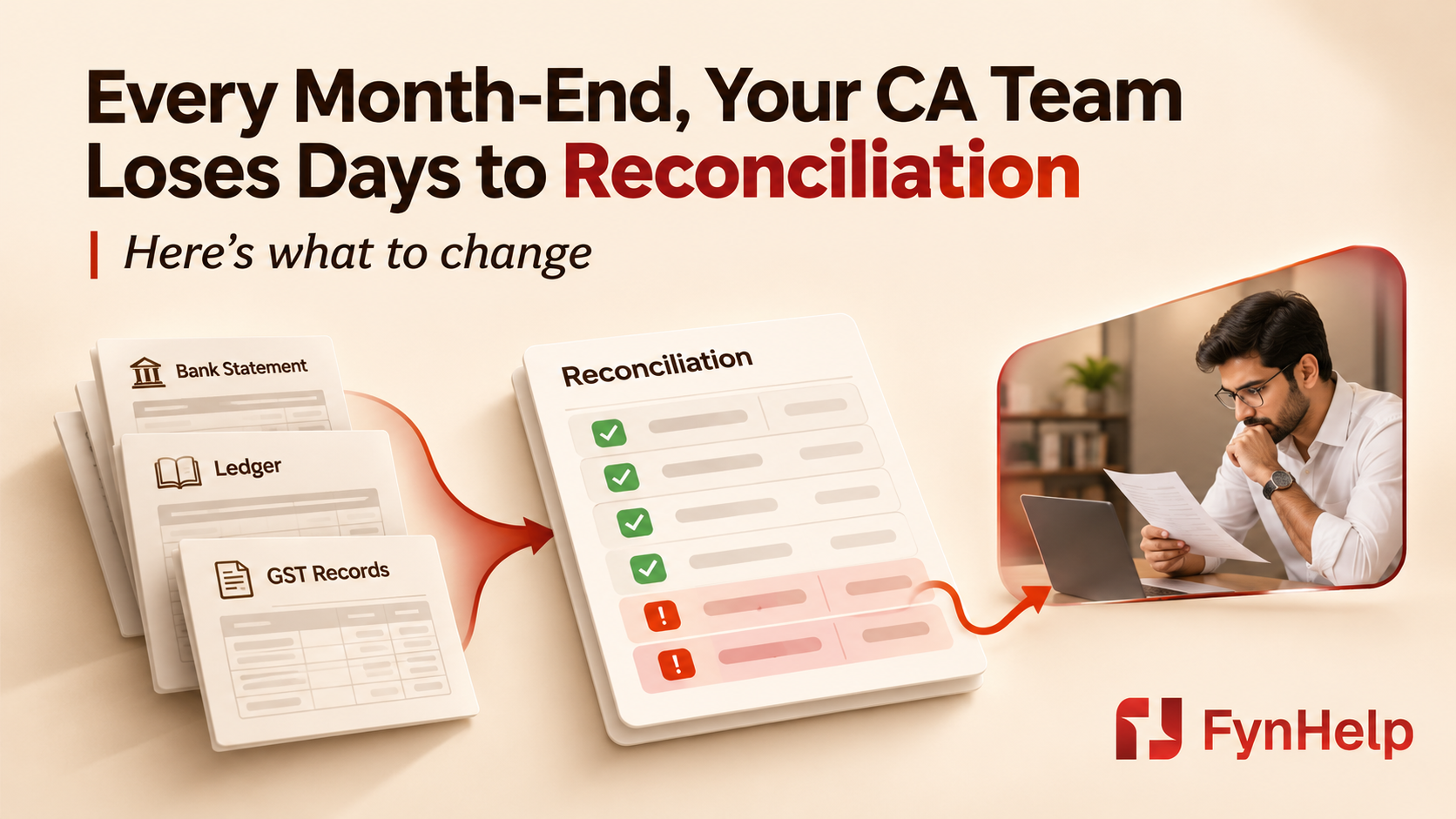
Month-end reconciliation takes days in many CA firms because staff manually collect bank statements, compare them against ledgers and GST records, and investigate mismatches client by client. A more efficient approach separates clean matches from exceptions, so experienced people spend their time on the transactions that need judgement.
Your team may close the books every month.
But how many working days disappear before the numbers are ready to trust?
At the start of a new month, a familiar routine begins. Collect bank statements. Open the ledger. Download GST records. Compare entries. Investigate mismatches. Repeat for the next client.
One client sends a clean statement. Another sends a scanned PDF. A third shares bills over WhatsApp. The details change, but the matching process repeats across the whole portfolio.
Reconciliation is essential. The trouble is how much of it still depends on people manually finding, comparing, and checking information across documents and systems.
Why Does Month-End Reconciliation Take So Long?
Short Answer
Month-end reconciliation takes long because the same work repeats across every client, and each client's documents arrive in a different format. Time goes into finding files, confirming periods, reading statements, and matching entries before accounting judgement begins.
Practical Example
Take an illustrative firm with 30 client entities. If preparation and matching take two hours per client, that is 60 hours of work before a single exception has been investigated. The figures are hypothetical, but the pattern is familiar: small per-client tasks add up to a large block of month-end time.
Key Takeaway
Most of the delay sits in preparation and matching, not in the judgement the firm is actually paid for.
What Does Manual Reconciliation Cost a CA Firm?
Short Answer
Manual reconciliation costs more than hours. It is hard to price separately, it turns experienced staff into reviewers of repetitive work, and every unresolved difference delays the close.
Cost
What It Looks Like
Unpriced workload
Reconciliation is bundled into a monthly retainer, even as clients add bank accounts, transactions, and invoices
Senior time on routine work
Managers check spreadsheets instead of coaching teams or investigating material exceptions
Slow learning for juniors
Early years go to matching routine entries rather than interpreting financial information
Open uncertainty
An unexplained credit or a vendor-name mismatch needs follow-up before the period can close
Key Takeaway
The workload grows with client complexity, while fees and team time rarely grow at the same pace.
Why Is Reconciliation a Triage Problem?
Short Answer
Reconciliation is triage: identify what agrees, isolate what does not, and direct experienced people to the cases that need judgement. Treating every transaction as equally worth a manual check is what makes the process slow.
All Transactions → Clean Matches → Exceptions → Human Judgement
Practical Example
A client's statement has 400 entries. If 360 match the ledger cleanly, checking all 400 by hand gives the 360 routine entries the same attention as the 40 ambiguous ones. Triage processes the 360 consistently and puts the 40 in front of a person with context.
Key Takeaway
Good reconciliation sorts transactions by how much judgement they need before anyone starts reviewing.
Which Transactions Are Hardest to Reconcile?
Short Answer
The hardest transactions are those where the bank entry does not point clearly to a ledger record: unclear narrations, one payment settling several invoices, and vendor names recorded differently.
Transaction
Why It Is Hard
UPI entry showing a phone number
No vendor name to match against
One receipt, several invoices
A single bank entry has to be split across bills
Shortened vendor name
Bank and ledger record the same party differently
Scanned statement
Entries must be read before they can be compared
Practical Example
A bank credit of ₹3,85,000 arrives against four open invoices. Without a remittance advice, someone has to work out which combination of invoices adds up to that amount.
Key Takeaway
The difficult cases are few in number but take the most investigation time.
How Do GST Differences Add to the Workload?
Short Answer
GST reconciliation adds a second layer of matching, comparing purchase records against supplier-reported information. Differences in input tax credit need investigation and, where required, a timely response.
Practical Example
A purchase of ₹5,00,000 with ₹90,000 of GST is recorded in the books, but the supplier's reported data does not show it. The team needs to establish why before treating the credit with confidence, which usually means contacting the client or supplier.
Key Takeaway
GST differences are rarely quick fixes, so discovering them late squeezes the time available to resolve them.
What Should Automation Handle, and What Should People Decide?
Short Answer
Automation suits extraction and routine matching. People should decide how ambiguous transactions are treated and what goes into the books. Automation should never mean accepting every match blindly.
Suited to Automation
Needs Professional Judgement
Reading bank statements and invoices
Treatment of an unexplained credit
Matching transactions with clear references
Splitting one payment across several invoices
Flagging GST differences
Whether a GST difference needs escalation
Preparing source-traceable MIS packs
Final review and posting of entries
Key Takeaway
Let software narrow the field and let people decide the cases that remain.
How Does Manual Reconciliation Affect Juniors and Managers?
Short Answer
Juniors spend their early years matching routine entries, and managers spend review time checking spreadsheets. Both lose time that could go to interpretation and coaching.
Practical Example
A manager receives eight client spreadsheets, each laid out differently. Reviewing them means first understanding each layout, then checking the matches, then writing back corrections. The same review on a consistent exception list takes a fraction of the orientation effort.
Key Takeaway
When review time goes into reconstructing work, it is not available for teaching.
How Should You Measure Reconciliation Effort?
Short Answer
Measure effort, not just output. Track the time spent preparing files, the number of manual matches, the exceptions needing investigation, the review rounds per client, and the time needed to explain a figure.
Metric
What It Shows
Preparation time
Cost of document handling
Manual matches
How much routine work remains
Exceptions per client
Where judgement time goes
Review rounds
Rework between juniors and managers
Time to trace a figure
Quality of source evidence
Key Takeaway
A tool should be judged by how much manual work disappears, not how many transactions it touches.
Where Should a CA Firm Start?
Short Answer
Review the last month-end cycle, identify which clients generated the most manual work, and test any new workflow on those difficult cases instead of only on clean data.
Look for scanned statements, inconsistent narrations, payments covering multiple invoices, missing documents, GST differences, and spreadsheets that went through several review rounds.
Key Takeaway
A pilot on your hardest clients tells you more than a demo on clean data.
How FynHelp Fits Into the Existing Workflow
FynHelp is an AI-powered intelligence layer that works above existing accounting systems such as Tally and Zoho Books.
It extracts information from bank statements, invoices, and GST documents, reconciles books against bank and GST data, and surfaces exceptions for review. It can also produce MIS and narration packs in which figures can be traced back to source documents.
Documents → Extraction → Reconciliation → Exceptions → Human Review
FynHelp does not write to the ledger. The firm's team keeps control over posting entries and remains responsible for professional review.
Book a Demo
If your team spends too much of every month matching documents by hand, book a demo with FynHelp to see how it supports month-end close alongside your current accounting setup. Visit fynhelp.com.
Conclusion
Month-end reconciliation is necessary, and for many CA firms it is also the biggest drain on team time.
The better division of labour is simple: software handles extraction and routine matching, exceptions arrive with context, and experienced people spend their time on judgement.
Collect → Extract → Reconcile → Surface Exceptions → Review → Close
Review last month's close, find where the manual hours went, and test a new workflow on the hardest cases first.
Frequently Asked Questions
Why does month-end reconciliation take so long for CA firms?
The same matching work repeats across every client, and documents arrive in mixed formats. Preparation, matching, and follow-ups use up time before judgement-based review can start.
Can reconciliation be automated without losing control?
Extraction and routine matching can be automated while people keep control of ambiguous cases and ledger entries. Exceptions should be surfaced for review, not silently resolved.
Does FynHelp replace Tally or Zoho Books?
No. FynHelp works alongside existing accounting systems and does not write to the ledger.
How should a firm evaluate a reconciliation tool?
Test it on difficult clients, such as scanned statements and inconsistent narrations, and track whether exceptions are found sooner and evidence is easier to review.
What is the first step to improving month-end close?
Review the last close and identify which clients and document types created the most manual work.
Keep reading
- Junior Accountants Should Learn Judgement, Not Spend Years as Matching MachinesReconciliation · 7 min read
- GST Mismatches, Unidentified Credits and Missing Invoices, Stop Letting Exceptions Hide in SpreadsheetsReconciliation · 8 min read
- Don't Replace Tally or Zoho Books. Fix the Work Happening Around ThemReconciliation · 9 min read
How FynHelp helps
FynHelp runs a CA firm's month-end close in four steps: bank statement and Tally export extraction, bank reconciliation, source-traceable MIS reports and automated document follow-ups. See pricing for CA firms.
FynHelp reads statements and Tally exports, matches bank to books and drafts the MIS. Free to start, no card needed.
Start free trial