
How CA Firms Can Create MIS Reports That Every Number Can Be Traced Back to Its Source
By FynHelp Team, Editorial
Introduction
A monthly MIS is not just a collection of totals. It is a financial story that a business owner or management team should be able to understand and question.
For a CA firm, preparing that story means ensuring that the figures are complete, reconciled, and supported by records. When numbers are copied across spreadsheets, the connection to their original source can become difficult to follow.
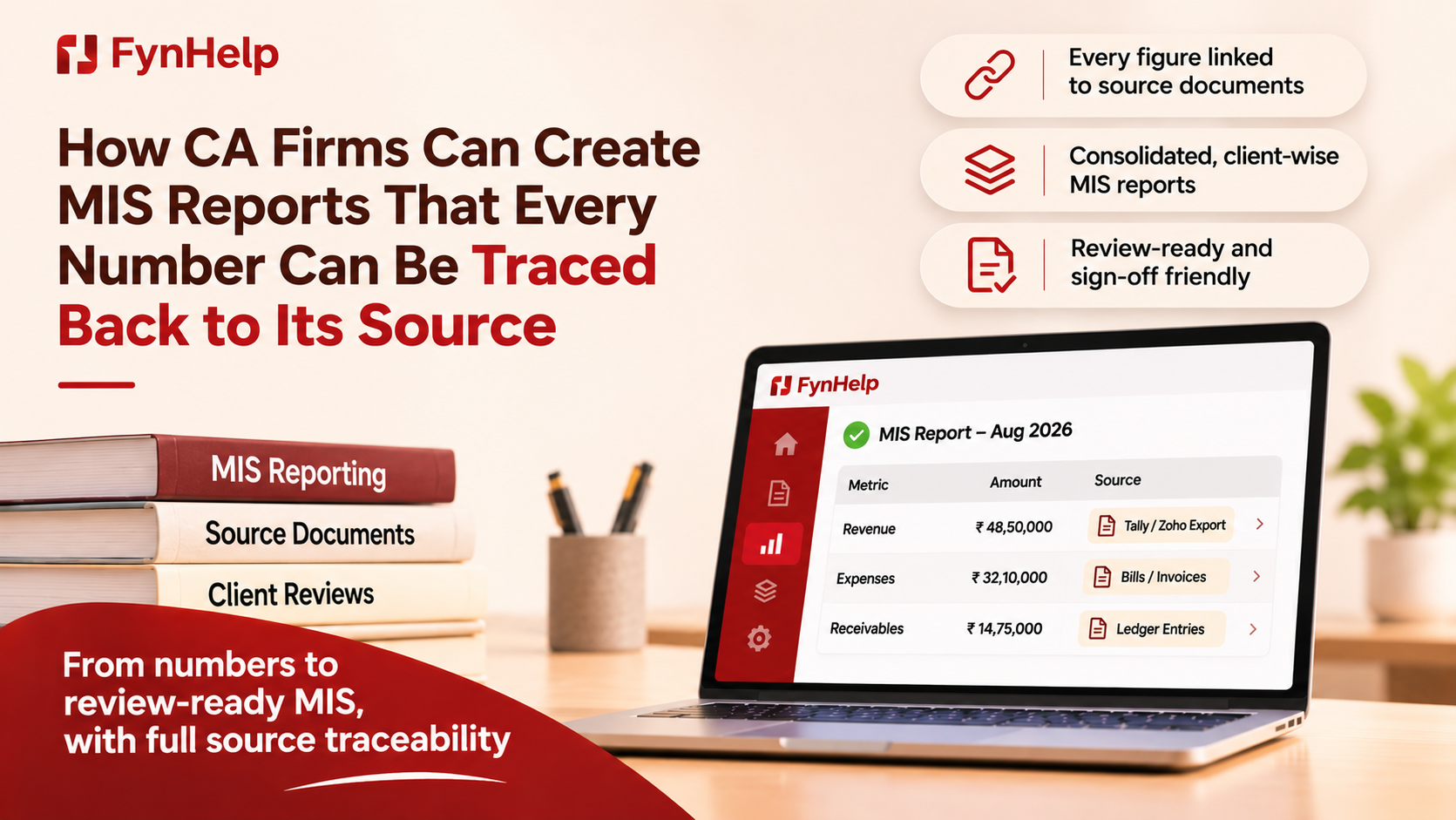
A source-traceable MIS makes the evidence behind each figure part of the report, rather than something the team has to reconstruct later.
Table of Contents
Why is preparing an MIS report still time-consuming?
What makes an MIS report source-traceable?
Why are spreadsheets alone not enough?
How should MIS figures be calculated?
What is the role of narrative commentary?
How does source traceability improve review?
What should CA firms look for in MIS software?
How to build a dependable MIS workflow
How FynHelp fits into MIS preparation
Conclusion
Frequently Asked Questions
Internal Linking Suggestions
Fact Check Notes
Detailed Blog Sections
1. Why Is Preparing an MIS Report Still Time-Consuming?
Short Answer. Preparing a monthly MIS involves more than placing figures into a template. The team must collect source data, confirm that the period is complete, reconcile transactions, calculate financial measures, investigate unusual movements, and explain what changed.
Practical Example. A manager may receive several spreadsheets from different clients and spend time checking whether each figure agrees with the underlying records before writing the commentary. The reporting deadline often arrives after the reconciliation work has already consumed the team's time.
Key Takeaway. The reporting bottleneck often begins upstream, with fragmented and unverified source data.
2. What Makes an MIS Report Source-Traceable?
Short Answer. A source-traceable MIS report links each reported figure to the underlying records used to produce it. A reviewer should be able to identify the relevant bank and book lines, understand the reporting period, and see the basis for the figure.
Practical Example. If the report shows ₹8,40,000 in customer receipts, the reviewer should be able to inspect the matched transactions that contribute to that total rather than relying on a copied spreadsheet value.
Key Takeaway. A figure should be more than plausible; its source should be inspectable.
3. Why Are Spreadsheets Alone Not Enough?
Short Answer. Spreadsheets are useful for analysis, but repeated copying and versioning can weaken the connection between a reported figure and its original source. Formulas may be overwritten, tabs may become outdated, and separate copies can drift.
Practical Example. A team may prepare an MIS from one export, revise it after a review comment, and later circulate a different workbook. Without a clear source trail and version discipline, it becomes difficult to establish which data supported the final number.
Key Takeaway. The risk is not that spreadsheets are inherently unreliable; it is that copied data can lose its context.
4. How Should MIS Figures Be Calculated?
Short Answer. MIS calculations should use clearly defined inputs and consistent logic. The source records should be identified, the reporting period should be explicit, and calculations should be reproducible. Missing data should remain visible rather than being replaced with invented or placeholder values.
Practical Example. For example, a monthly expense figure should be built from the relevant recorded transactions for the period, with exclusions or adjustments documented. A reviewer should be able to trace the total back to its contributing lines.
Key Takeaway. Reliable reporting depends on controlled calculations and complete source context.
5. What Is the Role of Narrative Commentary?
Short Answer. Narrative commentary explains what changed, where the movement occurred, and what may require attention. It should distinguish observed facts from possible explanations and avoid claiming a cause that the available data does not establish.
Practical Example. If travel expenses increased by 18%, the report can state the movement and identify the accounts contributing to it. It should not claim that the increase was caused by expansion unless the supporting business context confirms that explanation.
Key Takeaway. Good commentary interprets the numbers without overstating what the data proves.
6. How Does Source Traceability Improve Review?
Short Answer. Source links reduce the effort required to verify reported figures and investigate questions. Reviewers can move from a summary to the records behind it, check the supporting entries, and retain notes about decisions.
Practical Example. When a partner asks about a material movement, the team can open the contributing book and bank lines rather than searching through multiple exported files and email attachments.
Key Takeaway. Traceability turns review from reconstruction into verification.
7. What Should CA Firms Look for in MIS Software?
Short Answer. Look for transparent calculations, source links, clear reporting periods, matched-data inputs, exception visibility, commentary that distinguishes fact from interpretation, and a review trail. Confirm whether the product uses only reconciled data or includes unresolved entries.
Practical Example. Ask the provider to click a figure in a sample MIS and show the exact source lines behind it. Then ask how missing records, unmatched transactions, and later corrections are represented.
Key Takeaway. Evaluate the evidence behind the report, not just the appearance of the dashboard.
8. How to Build a Dependable MIS Workflow
Short Answer. A dependable workflow starts with document collection, extraction, reconciliation, exception review, and only then MIS preparation. This sequence reduces the chance that unresolved transactions silently flow into a management report.
Practical Example. A firm can define a monthly cut-off, assign responsibility for missing documents, review exception queues, and generate the MIS from the approved matched dataset. Any material adjustment should be documented under the firm's normal controls.
Key Takeaway. A trustworthy MIS is the output of a controlled close process, not a standalone design exercise.
7. How FynHelp Fits Into the Existing Workflow
FynHelp's Narrate agent prepares a monthly MIS from matched financial lines, with each figure linked to the bank and book lines behind it. The workflow begins with document intake and extraction, followed by reconciliation and exception review. This matters because a report should not disguise missing data or unresolved differences as confirmed figures. FynHelp computes MIS figures in code and uses AI to read documents and draft commentary; it does not ask AI to invent or calculate financial values. The firm's team remains responsible for review and sign-off, and FynHelp does not write to the ledger.
Book a Demo
If your firm wants to reduce repetitive month-end work while keeping its existing accounting system and review controls, explore FynHelp at https://fynhelp.com or book a walkthrough with the team.
8. Conclusion
An MIS is trustworthy when its figures can be verified and its commentary stays within what the data supports. Source traceability reduces the work of checking a report and makes client or partner questions easier to answer. Build the reporting process on matched records, visible exceptions, controlled calculations, and professional review.
9. Frequently Asked Questions
What is a source-traceable MIS report?
It is a management report where each figure can be traced to the underlying records used to produce it.
Why should MIS reports link to source transactions?
Source links help reviewers verify totals, investigate movements, and answer questions without reconstructing the calculation from disconnected files.
Can AI write MIS commentary?
AI can help draft commentary, but the statements should be grounded in verified financial data and reviewed by the firm. Observed movements should be separated from unverified explanations.
Should an MIS include unmatched transactions?
Unmatched items should be clearly identified and handled according to the firm's reporting policy. They should not silently be treated as confirmed matched figures.
How does FynHelp prepare MIS reports?
FynHelp's Narrate agent prepares MIS from matched financial lines and links figures to the underlying bank and book records for review.
Keep reading
- Tally Bank Statement Import Automation: What CA Firms Should KnowReconciliation · 6 min read
- Junior Accountants Should Learn Judgement, Not Spend Years as Matching MachinesReconciliation · 7 min read
- GST Mismatches, Unidentified Credits and Missing Invoices, Stop Letting Exceptions Hide in SpreadsheetsReconciliation · 8 min read
How FynHelp helps
FynHelp runs a CA firm's month-end close in four steps: bank statement and Tally export extraction, bank reconciliation, source-traceable MIS reports and automated document follow-ups. See pricing for CA firms.
FynHelp reads statements and Tally exports, matches bank to books and drafts the MIS. Free to start, no card needed.
Start free trial