
AI Bank Statement Analyzer for CA Firms
By FynHelp Team, Editorial
Introduction
A bank statement is one of the most familiar documents in a CA firm's month-end workflow. Yet reading it is only the first step.
Before a transaction can be reconciled, someone has to turn the statement into usable data: dates, narrations, debits, credits, and balances. Across multiple clients, that preparation becomes repetitive work.
The real question is not whether a PDF can be converted into a table. It is whether the extracted information is accurate, traceable, and ready for review.
Table of Contents
Why do CA firms need a bank statement analyzer?
What does a bank statement analyzer actually do?
How does statement extraction work?
Why extraction alone is not enough
What happens when a transaction cannot be matched?
What should remain under human review?
How should a firm evaluate an analyzer?
Common bank statement data challenges
How FynHelp fits into the workflow
Conclusion
Frequently Asked Questions
Internal Linking Suggestions
Fact Check Notes
6. Detailed Blog Sections
1. Why Do CA Firms Need a Bank Statement Analyzer?
Short Answer. A bank statement analyzer helps reduce the manual effort involved in reading transaction lines before reconciliation. In a multi-client practice, statements arrive in different layouts and formats. Staff must identify the account period, read dates and narrations, capture debits and credits, and prepare the information for comparison with the books.
Practical Example. Consider a firm handling 25 client entities. Each entity may have one or more bank accounts, and each statement can contain dozens or hundreds of lines. Even a few minutes spent checking every file adds up across the portfolio. This is an illustrative workload, not a measured industry average.
Key Takeaway. The value is not simply converting a PDF into a spreadsheet. It is making statement data usable for the next accounting step.
2. What Does a Bank Statement Analyzer Actually Do?
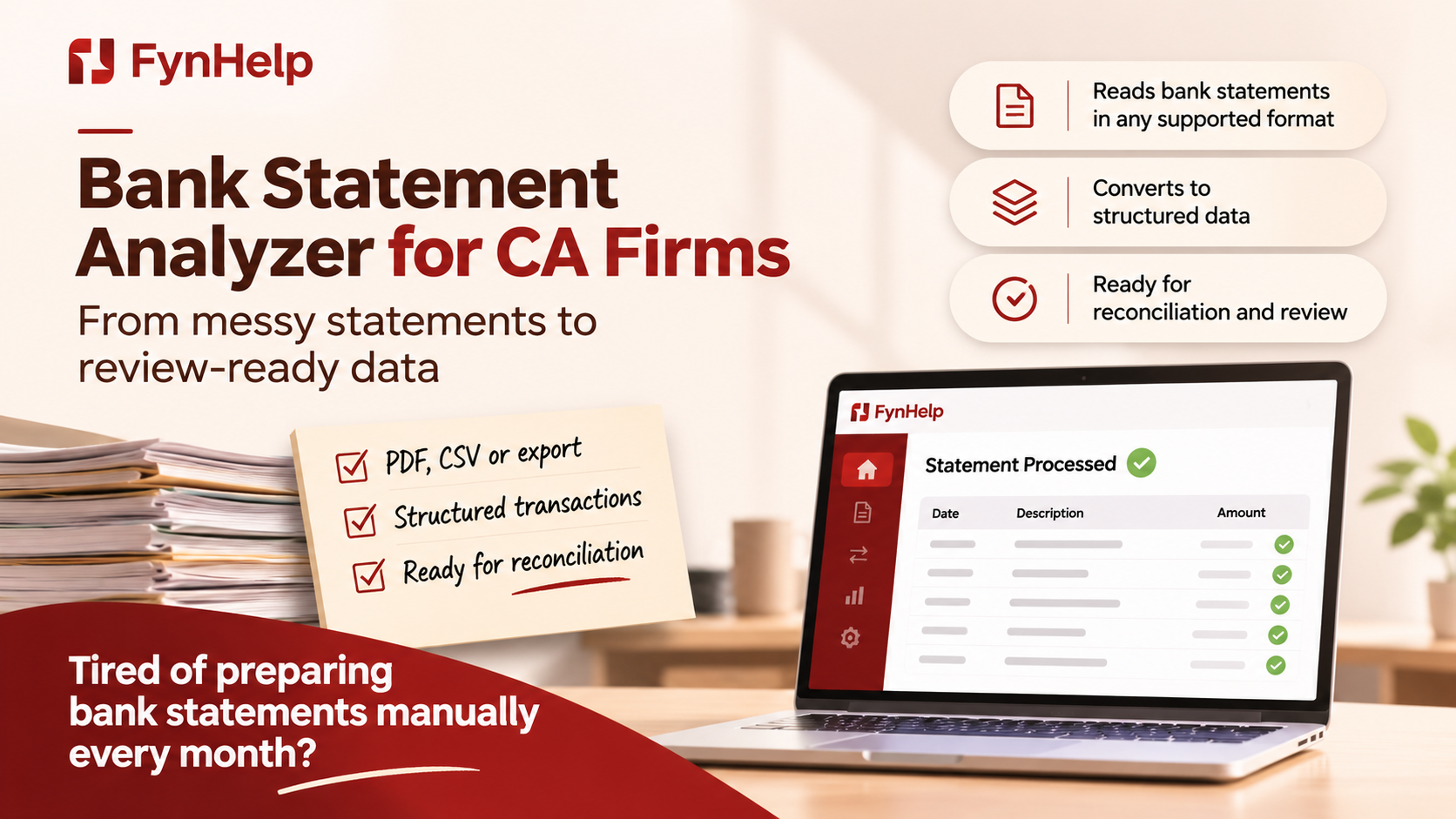
Short Answer. A statement analyzer reads a supported bank statement and identifies transaction-level fields such as date, narration, debit, credit, and balance where available. The output is structured data that can be checked, reconciled, and reviewed.
Practical Example. For example, a statement line may show a NEFT debit with a shortened beneficiary name. Extraction captures the transaction details; reconciliation later checks whether the entry corresponds to a payment recorded in the ledger.
Key Takeaway. Extraction prepares the evidence. It does not, by itself, establish the accounting treatment or prove that a transaction is correctly recorded.
3. How Does Statement Extraction Work?
Short Answer. A typical workflow starts with document intake, file classification, reading, field extraction, and validation. The extracted lines should remain associated with the source document so a reviewer can verify the original entry.
Practical Example. A practical sequence is: receive the statement; identify the statement period and account; extract transaction rows; structure the fields; check totals and date coverage; then pass the lines to reconciliation. If a file is unreadable or information is missing, the workflow should flag the issue rather than silently invent a value.
Key Takeaway. Reliable extraction includes validation and source context, not just text recognition.
4. Why Is Extraction Alone Not Enough?
Short Answer. A structured statement is only one side of reconciliation. The accounting records provide the other side. The two datasets must be compared using transaction details, amounts, dates, references, and any firm-defined matching rules.
Practical Example. A bank debit of ₹72,300 may appear in the books as ₹72,500 because of a timing difference, bank charge, or data-entry issue. Extraction can read both values, but it cannot decide the reason without further evidence.
Key Takeaway. The next step after extraction is matching and exception analysis.
5. What Happens When a Transaction Cannot Be Matched?
Short Answer. Unmatched entries should be separated into an exception queue with a clear reason and relevant source information. This lets staff investigate the small set of transactions that need attention instead of repeatedly checking every line.
Practical Example. A transaction may remain unmatched because the posting date differs, the narration is abbreviated, one bank payment settles multiple invoices, or the corresponding book entry is missing. A useful workflow shows the original bank line and plausible candidate entries without treating a suggestion as an approved decision.
Key Takeaway. An exception should explain what needs investigation and why.
6. What Should Remain Under Human Review?
Short Answer. People should retain control over ambiguous matches, accounting treatment, adjustments, ledger posting, and final sign-off. Automation can identify likely matches and organise evidence, but professional judgement remains necessary where the records do not establish a clear answer.
Practical Example. If one payment covers three invoices, the reviewer may need remittance advice or client confirmation before allocating it. The system can surface candidate records, but the firm decides how the transaction is treated.
Key Takeaway. Automate repetitive preparation; retain human authority over accounting decisions.
7. How Should a Firm Evaluate an Analyzer?
Short Answer. Evaluate the analyzer on real-world document variation, extraction quality, traceability, exception handling, and the time required for review. Do not judge it only on a clean sample statement.
Practical Example. Test statements with long narrations, multiple pages, different date formats, high transaction volumes, and unusual debit or credit descriptions. Check whether extracted totals can be compared with the source and whether a reviewer can open the original line.
Key Takeaway. A good pilot tests difficult files and the complete workflow, not just whether text appears in a table.
8. Common Bank Statement Data Challenges
Short Answer. Common challenges include inconsistent bank layouts, multi-page PDFs, unclear narrations, date and value-date differences, duplicate files, missing pages, and transactions split across several accounting entries.
Practical Example. A statement may show a UPI reference rather than a supplier name. Another may contain a consolidated settlement that corresponds to multiple book entries. The correct response is to preserve the source detail and route uncertainty for review.
Key Takeaway. Do not hide uncertainty behind a clean-looking spreadsheet.
7. How FynHelp Fits Into the Existing Workflow
FynHelp is designed for CA firms that work across multiple client entities and use existing accounting systems. Its Extract agent reads supported statements, Tally exports, and GST and TDS registers into structured lines. Recon then compares bank and book records through exact, fuzzy, and firm-rule matching, with unmatched items surfaced as exceptions with reason codes. Narrate prepares a monthly MIS from matched lines, with figures linked to the underlying bank and book lines. FynHelp works above the firm's existing ledger workflow; it is read-only and does not write entries into Tally or Zoho Books.
Book a Demo
If your firm wants to reduce repetitive month-end work while keeping its existing accounting system and review controls, explore FynHelp at https://fynhelp.com or book a walkthrough with the team.
8. Conclusion
A bank statement analyzer is valuable when it produces structured, verifiable transaction data that can move into reconciliation. Extraction should preserve the source, validation should surface uncertainty, and people should remain responsible for accounting decisions. For a CA firm, that is the difference between digitising a statement and improving the month-end workflow.
9. Frequently Asked Questions
Can a bank statement analyzer read PDF statements?
It depends on the product and the file. Check supported PDF formats and test statements from the banks your clients use. FynHelp reads supported bank statement files; image/photo reading should not be assumed unless explicitly supported.
Does statement extraction complete bank reconciliation?
No. Extraction structures the bank data. Reconciliation compares it with accounting records and investigates unmatched entries.
Can an analyzer identify every transaction correctly?
No tool should be assumed to be error-free. Validate extracted fields against the source and route uncertain or incomplete records for review.
Does FynHelp replace Tally or Zoho Books?
No. FynHelp works alongside existing accounting systems and does not write to the ledger.
What should a CA firm test first?
Test representative statements, including long narrations and difficult layouts, and check extraction, source traceability, matching, and exception review end to end.
Keep reading
How FynHelp helps
FynHelp runs a CA firm's month-end close in four steps: bank statement and Tally export extraction, bank reconciliation, source-traceable MIS reports and automated document follow-ups. See pricing for CA firms.
FynHelp reads statements and Tally exports, matches bank to books and drafts the MIS. Free to start, no card needed.
Start free trial