
Automated Bank Reconciliation for Accountants in India
By FynHelp Team, Editorial
Introduction
Bank reconciliation is routine accounting work. In a CA practice, however, routine does not mean small.
The same comparison repeats across client entities, bank accounts, and accounting periods. Staff prepare files, compare entries, investigate differences, and send unresolved items back for clarification.
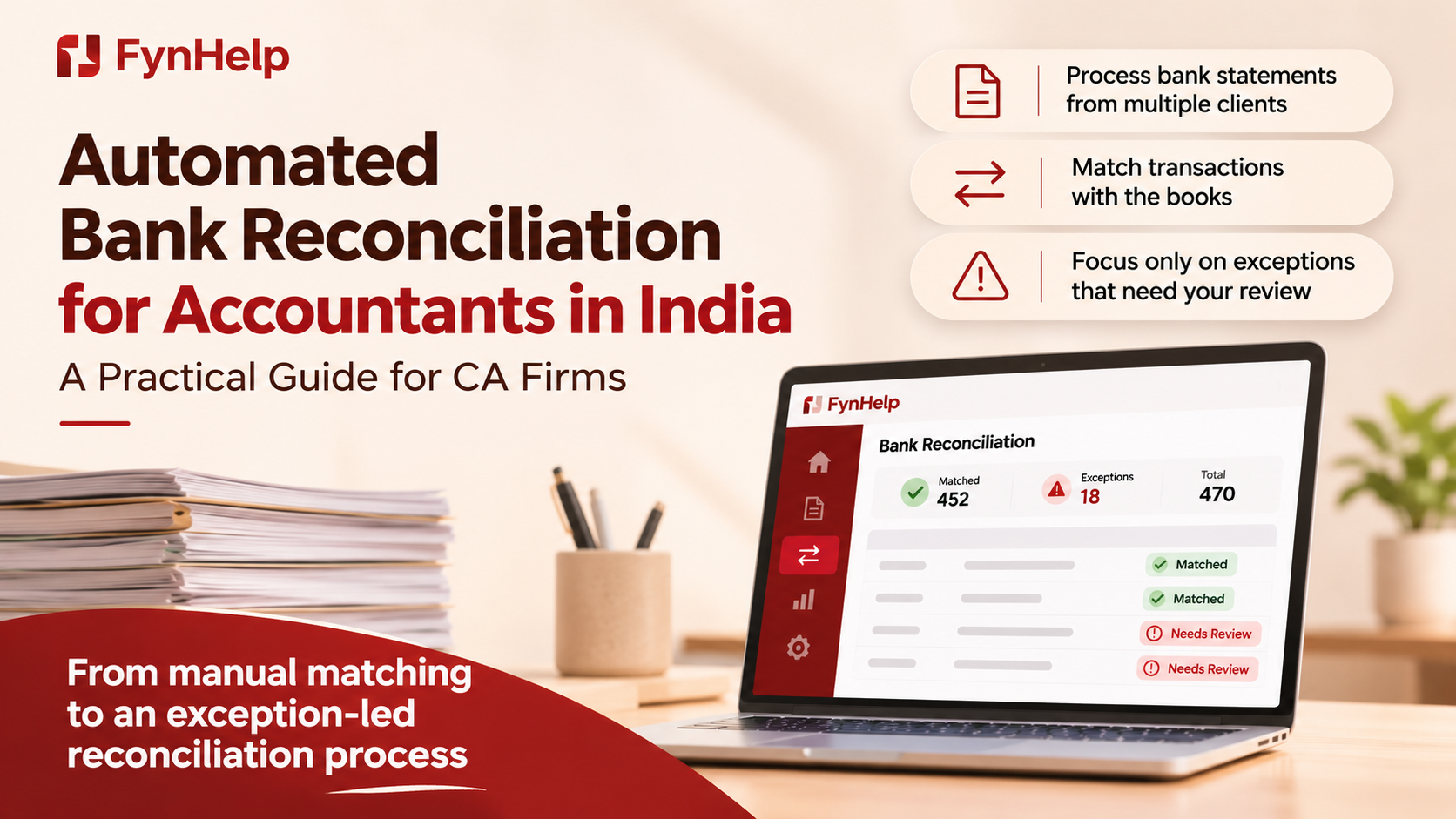
Automation can reduce the repetitive matching effort, but only if the firm can still understand why a match was made and review what remains unresolved.
Table of Contents
Why is bank reconciliation still manual?
What is automated bank reconciliation?
How does the matching process work?
Why do exact matches fail?
How should exceptions be handled?
Where does human review fit?
What should Indian accounting firms look for?
How to introduce automation into a CA practice
How FynHelp fits into the workflow
Conclusion
Frequently Asked Questions
Internal Linking Suggestions
Fact Check Notes
1. Why Is Bank Reconciliation Still Manual?
Short Answer. Many accounting teams still compare bank statements and ledger exports across separate files. The work becomes repetitive when the same process must be completed for several clients, accounts, and periods. The difficulty is not limited to finding equal amounts; staff also need to investigate timing differences, incomplete references, and missing postings.
Practical Example. For example, a firm may receive a bank statement for one client, export the ledger, sort both files, and compare entries line by line. The same steps are repeated for the next entity, often with a different file layout.
Key Takeaway. The manual burden is created by repeated preparation and investigation across the client portfolio.
2. What Is Automated Bank Reconciliation?
Short Answer. Automated bank reconciliation uses software to compare bank transactions with accounting records according to matching criteria. It can identify exact matches, find likely matches where dates or descriptions vary, and flag entries that need investigation.
Practical Example. A bank credit and a ledger receipt with the same amount and reference may be an exact match. A payment recorded one day later with a shortened narration may be a candidate for a close match, subject to the firm's rules.
Key Takeaway. Automation should make matching explainable, not turn every suggested match into an unquestioned approval.
3. How Does the Matching Process Work?
Short Answer. A reliable workflow first prepares bank and book data in a consistent structure. It then applies matching logic, records the basis for each match, and separates unmatched or ambiguous items for review.
Practical Example. A common sequence is exact matching, fuzzy or close matching, and firm-defined rules. The order and thresholds should be visible to the firm. A match should retain references to the bank line and book line that support it.
Key Takeaway. A useful reconciliation process is structured, repeatable, and auditable.
4. Why Do Exact Matches Fail?
Short Answer. Exact matching fails when the same underlying transaction is represented differently in the bank and books. Common causes include posting-date differences, shortened narrations, bank charges, split settlements, consolidated receipts, and partial payments.
Practical Example. A bank may show a payment as 'NEFT DR ABC TRD' while the ledger uses the supplier's full legal name. The amount may agree even though the text does not. A matching rule can identify a candidate, but the reviewer still needs enough context to approve it.
Key Takeaway. A system needs more than amount equality, but more flexible matching must remain explainable.
5. How Should Exceptions Be Handled?
Short Answer. Exceptions should be grouped into a queue with a reason, source details, and possible candidate entries where available. This gives the accountant a focused investigation list.
Practical Example. Examples include no book entry found, amount difference, date gap, duplicate-looking transaction, or unclear narration. The reviewer can inspect the source records, request supporting information, and record the decision and note.
Key Takeaway. The exception queue is where automation hands work to professional judgement.
6. Where Does Human Review Fit?
Short Answer. Accountants should retain control over uncertain matches, accounting treatment, adjustments, ledger posting, and sign-off. Automation is most useful when it removes routine comparisons and presents the remaining work with context.
Practical Example. If a bank debit appears to relate to a personal expense, the software should not decide its treatment. It can show the unmatched entry and related evidence; the accountant determines the correct accounting action.
Key Takeaway. The objective is to reduce repetitive checking without removing professional accountability.
7. What Should Indian Accounting Firms Look For?
Short Answer. Evaluate support for the formats your clients actually provide, compatibility with existing accounting exports, transparent matching logic, exception reasons, source traceability, role-based review, and a usable audit trail.
Practical Example. Run a pilot with a mix of clean and difficult client files. Include multiple bank accounts, unclear narrations, date gaps, and transactions that settle more than one invoice. Compare the time and review effort with the current process.
Key Takeaway. Choose a tool based on the complete month-end workflow, not a headline automation percentage.
8. How to Introduce Automation Into a CA Practice
Short Answer. Start with a defined group of client entities and one completed accounting period. Map how statements arrive, who prepares the books export, who resolves exceptions, and who signs off. Agree on what counts as an approved match and how unresolved items are escalated.
Practical Example. A firm could pilot the workflow with a few clients that have different transaction patterns. Record preparation time, exception volume, review rounds, and the time required to trace a figure. Expand only after the team is comfortable with the controls.
Key Takeaway. A controlled pilot creates better evidence than a firm-wide rollout based on assumptions.
7. How FynHelp Fits Into the Existing Workflow
FynHelp supports bank-to-book reconciliation for CA firms using existing accounting workflows. The firm uploads bank statements and Tally or Zoho exports; Extract structures the documents, and Recon applies exact, fuzzy, and firm-defined matching. Unmatched transactions are placed in an exception queue with reason codes and source context. The team reviews and records decisions in the audit trail. FynHelp is a layer above the ledger, not a replacement for Tally or Zoho Books, and it does not write to the ledger.
Book a Demo
If your firm wants to reduce repetitive month-end work while keeping its existing accounting system and review controls, explore FynHelp at https://fynhelp.com or book a walkthrough with the team.
8. Conclusion
Automated bank reconciliation should not mean accepting every suggested match. The strongest workflow applies clear rules to routine transactions, makes exceptions easy to investigate, and preserves human review for ambiguous cases. Firms should pilot automation on real client data and measure the complete review effort.
9. Frequently Asked Questions
Is automated bank reconciliation suitable for small CA firms?
It can be useful wherever teams repeat bank-to-book matching across clients. Suitability depends on transaction volume, file formats, controls, and the cost of the current process.
Does automation mean every transaction is matched automatically?
No. Some entries remain ambiguous or unsupported by available evidence. Those should be routed for human review.
Can bank reconciliation software work with Tally?
Some tools work with Tally exports or supported integrations. Confirm whether the workflow reads exports, imports data, or writes to the ledger; these are different capabilities.
How does FynHelp handle unmatched transactions?
Recon surfaces unmatched items in an exception queue with reason codes and source context for the team to review.
Will FynHelp post reconciled entries into my books?
No. FynHelp is read-only and does not write to the ledger.
Keep reading
How FynHelp helps
FynHelp runs a CA firm's month-end close in four steps: bank statement and Tally export extraction, bank reconciliation, source-traceable MIS reports and automated document follow-ups. See pricing for CA firms.
FynHelp reads statements and Tally exports, matches bank to books and drafts the MIS. Free to start, no card needed.
Start free trial