
On this page
- Client document collection becomes harder to coordinate
- Work ownership becomes unclear across the team
- Review capacity becomes a bottleneck
- Partners lose visibility across multiple clients
- Different employees follow different processes
- A practical operational health check for your CA firm
- How connected workflows support a growing CA firm
- Where FynHelp fits into this workflow
- Growth requires more than additional capacity
Growth is usually a positive sign for a CA firm.
More clients mean more assignments, a larger team, wider service offerings and greater business opportunities.
But growth also changes how a firm operates.
A process that works when a small team manages a limited number of clients may become difficult to coordinate as assignments, employees and client requirements increase.
Document requests start coming from multiple channels. Work gets distributed across more people. Review queues become harder to monitor. Partners need more frequent updates to understand what is happening across the practice.
The challenge is not necessarily that the firm has too much work.
It may be that the operational structure has not evolved at the same pace as the business.
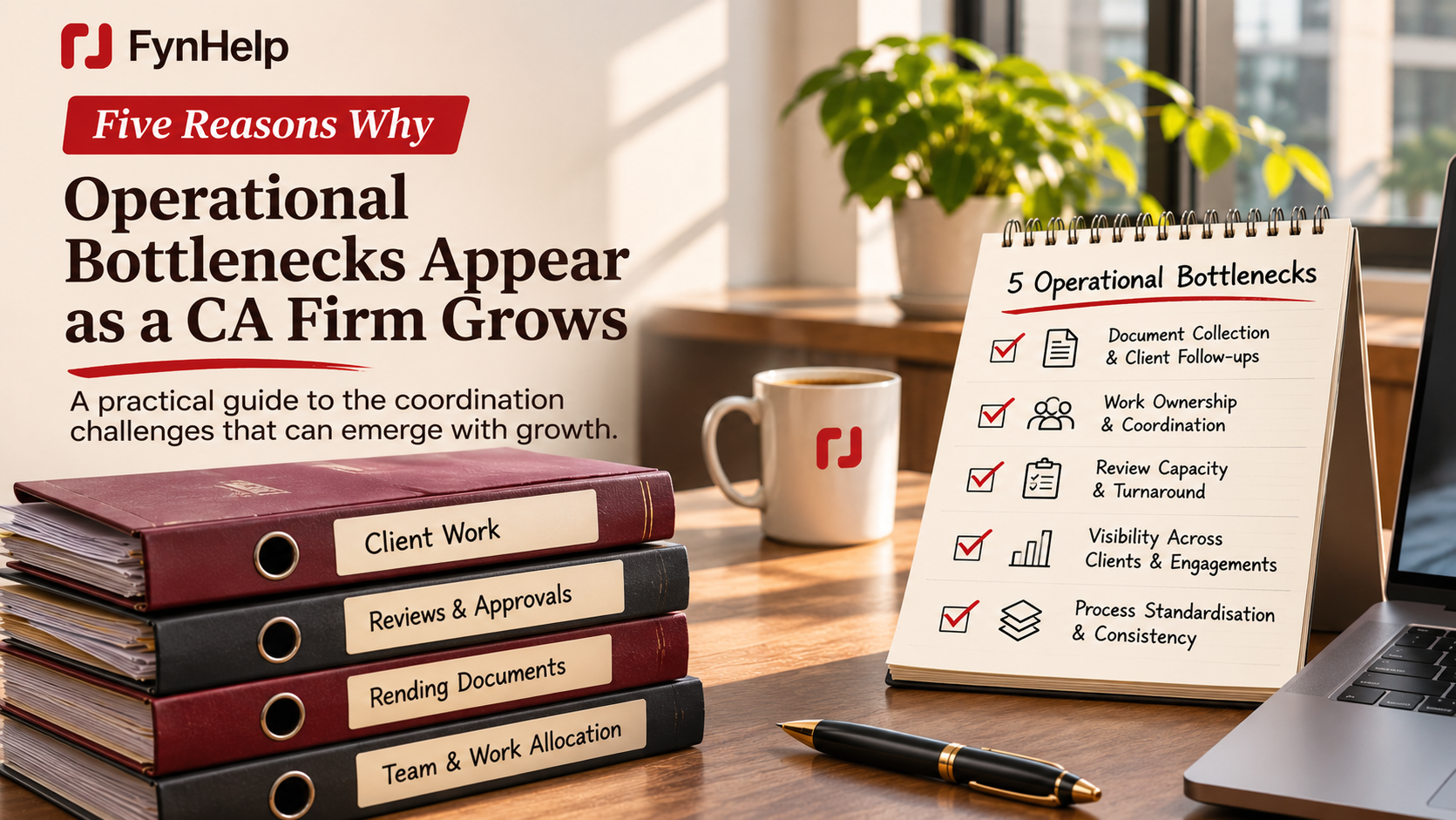
Here are five operational bottlenecks that CA firms should watch as they grow.
Client document collection becomes harder to coordinate
Document collection is one of the first operational activities worth examining.
Every client may require different documents, reporting periods and supporting information. These requests may be communicated through email, WhatsApp, phone calls or other channels.
As the number of active assignments increases, tracking every request manually can become difficult.
The team may need to repeatedly check:
Which clients have submitted their bank statements?
Which invoices are still pending?
Has the client shared the complete set of documents?
Who sent the last reminder?
Which submissions need clarification?
When there is no central view, employees may spend considerable time locating information and confirming request status.
What to improve
Create a structured document collection process.
Every request should have:
A clearly identified client and reporting period.
A specific list of required documents.
A responsible team member.
A current status.
A record of follow-ups and clarifications.
The objective is to make document collection visible and trackable rather than dependent on individual memory.
Work ownership becomes unclear across the team
In a growing firm, several employees may work on different clients and assignments simultaneously.
A task may pass from one employee to another for processing, clarification or review.
Without clear ownership, questions begin to arise:
Who is responsible for this client?
Who is following up on the missing information?
Who needs to resolve this reconciliation exception?
Has the assignment been handed over for review?
Who is responsible for the next action?
When ownership is unclear, tasks can remain pending even when the required information is available.
It can also lead to duplicated work, repeated internal communication and missed handovers.
What to improve
Establish ownership at the assignment and task level.
Every active task should have a responsible person, a defined next action and a visible status. When work moves to another team member, the handover should also be clear.
This helps employees understand their responsibilities and gives managers better visibility into pending work.
Review capacity becomes a bottleneck
Processing work and reviewing work are two different stages.
As a firm grows, accountants may complete assignments faster than partners or senior reviewers can examine them.
This can create a growing queue of completed work awaiting verification.
For example, an assignment may have completed document collection, data processing and reconciliation but still be waiting for review.
Without visibility into review queues, partners may discover delays only when deadlines approach.
What to improve
Make review status visible across assignments.
The team should be able to identify:
Work currently being processed.
Work ready for review.
Work awaiting clarification.
Work returned for correction.
Work approved and completed.
Review capacity should also be considered when distributing assignments. Adding more processing capacity without considering the review stage may simply move the bottleneck further down the workflow.
FynHelp reads bank statements and Tally exports, matches bank to books, and hands you only the lines that need a decision. Nothing is posted without your approval.
Start free trialFree to start, no card neededPartners lose visibility across multiple clients
When a practice manages several client entities, understanding the status of each assignment becomes increasingly important.
Partners and managers need to know which clients have submitted their information, which assignments are in progress and which items require attention.
If this information is spread across spreadsheets, employee updates, folders and communication channels, getting an accurate picture may require repeated coordination.
A partner may have to ask different employees for updates before understanding the overall position.
What to improve
Build a consolidated operational view across active clients.
Useful information includes:
Client and entity details.
Current assignment status.
Pending document requests.
Unresolved reconciliation exceptions.
Responsible team members.
Work awaiting review.
Next actions and deadlines.
The purpose is not to create another reporting exercise. It is to make existing operational information easier to access.
Different employees follow different processes
As teams expand, employees may develop their own ways of handling similar assignments.
One person may use a spreadsheet to track missing documents. Another may maintain a WhatsApp follow-up list. Someone else may store review notes in a separate folder.
These approaches may work individually, but inconsistent processes make coordination and quality control more difficult.
They can also create dependency on specific employees who understand where information is stored and how a particular client is handled.
What to improve
Standardise recurring workflows wherever appropriate.
Define consistent processes for:
Client document requests.
File organisation and naming.
Data processing and validation.
Reconciliation and exception handling.
Task assignment and handovers.
Review and approval.
Assignment closure.
Standardisation does not mean every client must be handled identically. Different engagements may require different procedures. The objective is to establish a consistent operating foundation while allowing for client-specific requirements.
A practical operational health check for your CA firm
Before introducing another tool or increasing headcount, examine how your current practice operates.
Ask these questions:
Document collection
Can the team identify all pending client documents in one place?
Are requests specific to the client and reporting period?
Is there a clear owner for each follow-up?
Task ownership
Does every active assignment have a responsible employee?
Are handovers recorded clearly?
Can managers identify tasks without an assigned owner?
Review capacity
Can partners see which assignments are awaiting review?
Are review comments and corrections tracked?
Is work being distributed with review capacity in mind?
Cross-client visibility
Can managers understand the status of active clients without contacting individual employees?
Are pending exceptions visible?
Can the team identify which assignments need immediate attention?
Process standardisation
Do employees follow consistent document collection and processing procedures?
Are recurring tasks documented?
Can another team member take over an assignment without depending entirely on informal instructions?
These questions can help identify where operational improvements may be needed.
There is no universal client-count threshold at which these bottlenecks appear. Their impact depends on the firm's service mix, team structure, client complexity, technology and internal processes.
How connected workflows support a growing CA firm
The solution is not necessarily to replace existing accounting software or introduce more disconnected tools.
A growing firm needs a clear way to manage the activities surrounding its accounting work.
A connected workflow can organise the process into stages:
1. Collect client information
Track document requests, received files, missing information and follow-ups.
2. Process documents
Extract and structure information from supported documents, with appropriate validation.
3. Reconcile transactions
Match transactions where supported and organise unmatched items for investigation.
4. Prepare financial information
Use processed information to support monthly MIS preparation.
5. Review and monitor work
Give the team visibility into pending assignments, exceptions and work requiring review.
These stages create a more structured flow of information and responsibility across the practice.
Where FynHelp fits into this workflow
FynHelp is a practice intelligence and month-end close workflow platform built for CA firms.
It is designed to work alongside existing accounting systems such as Tally and Zoho rather than replace the firm's ledger.
Its workflow connects four key areas:
Chaser: Helps manage client document requests and follow-ups.
Extract: Processes supported financial documents and structures information.
Recon: Supports transaction matching and exception management.
Narrate: Supports monthly MIS preparation using processed financial information.
Together, these workflows aim to improve visibility and coordination across client work.
Accountants and partners remain responsible for validating information, investigating exceptions and reviewing outputs. The objective is to give teams a more organised way to manage recurring operational work.
Explore FynHelp: https://www.fynhelp.com
Growth requires more than additional capacity
A growing CA firm needs people who can deliver quality accounting and advisory work.
But it also needs processes that help those people coordinate assignments, manage client information and complete reviews effectively.
When document collection, ownership, review capacity, client visibility and standardisation are not addressed, operational complexity can increase alongside business growth.
The important step is to identify where work is getting delayed before deciding what needs to change.
A firm scales more sustainably when its people, processes and operational visibility grow together.
Explore how FynHelp supports connected workflows for CA firms: https://www.fynhelp.com.