
On this page
- Document requests are scattered across multiple channels
- Clients do not receive clear document instructions
- No clear ownership of client follow-ups
- The team cannot see the complete status of a client's documents
- There is no defined closure process for a request
- A practical client document request checklist
- How to improve the document collection workflow
- Where FynHelp Chaser fits in
- The question is not how many reminders your team sends
“Please share the bank statement.”
“Could you send the pending invoices?”
“We are still waiting for the supporting documents.”
If these messages are part of your team's regular routine, document collection may be consuming more time than it should.
For CA firms managing multiple client entities, collecting documents is not a one-time activity. It is a recurring part of bookkeeping, reconciliation, compliance preparation and month-end reporting.
The challenge is not simply getting clients to send files. It is ensuring that every request is communicated clearly, assigned to someone, tracked until completion and available to the team that needs it.
There is also a wider operational challenge here. Accounting software may manage financial records, but client document collection, follow-ups and assignment tracking require workflows beyond the ledger. Read more in our article: Accounting Software Does Not Manage Your Entire CA Practice.
So, why do CA teams keep chasing clients for the same documents?
Here are five possible reasons.
Document requests are scattered across multiple channels
A document request might be sent through WhatsApp, another through email and a third during a phone call.
When requests are spread across different channels, the team may not have one reliable place to check:
What has been requested?
What has already been received?
Which documents are still pending?
When was the last follow-up sent?
Who is responsible for following up?
Employees may end up checking multiple conversations or asking colleagues for updates.
What can improve this?
Maintain a central request tracker for each client. Every requested document should have a clear status, such as requested, received, under review or pending clarification.
Clients do not receive clear document instructions
A message saying “Please share the required documents” may not tell a client exactly what is needed.
The client may not know:
Which period the statement should cover.
Whether a PDF, Excel file or another format is required.
Which bank account or entity the request relates to.
Whether all pages or supporting schedules are needed.
Where the documents should be submitted.
Unclear requests can lead to incomplete submissions and additional rounds of communication.
What can improve this?
Use specific, standardised requests. Mention the document name, relevant period, required format and submission method. Where possible, provide a checklist rather than sending multiple disconnected messages.
No clear ownership of client follow-ups
When several employees work on different clients, it may not always be clear who is responsible for collecting a pending document.
One employee may assume another has followed up. A manager may discover the missing information only when reviewing the assignment.
This creates avoidable delays and repeated coordination.
What can improve this?
Assign every request to a responsible team member. Make the owner, due date and current status visible so that pending requests do not depend on memory or informal updates.
FynHelp reads bank statements and Tally exports, matches bank to books, and hands you only the lines that need a decision. Nothing is posted without your approval.
Start free trialFree to start, no card neededThe team cannot see the complete status of a client's documents
Receiving one document does not mean the entire request is complete.
For example, a client may submit a bank statement but still have pending sales invoices, purchase bills or supporting schedules.
If the team tracks only conversations or individual file uploads, it may be difficult to identify what is still missing.
What can improve this?
Track document completeness against a client-specific checklist. The team should be able to distinguish between:
Requested documents.
Received documents.
Documents awaiting verification.
Incomplete or unreadable documents.
Documents requiring clarification.
This gives employees a clearer picture of what is needed before processing can move forward.
There is no defined closure process for a request
A document may arrive, but the request is not necessarily complete.
The file could be for the wrong period, contain missing pages or require clarification. If the request is marked complete immediately after an upload, the team may discover the issue much later.
Without a closure process, the same document may be requested again or an incomplete submission may move into the next stage.
What can improve this?
Define when a request can be closed. For example, a document request should move through clear stages:
Requested.
Received.
Checked for completeness.
Clarification required, if applicable.
Accepted and closed.
The person responsible should be able to see why a request remains open and what action is required next.
A practical client document request checklist
A standardised checklist can reduce ambiguity and make follow-ups more consistent.
For each client, consider tracking:
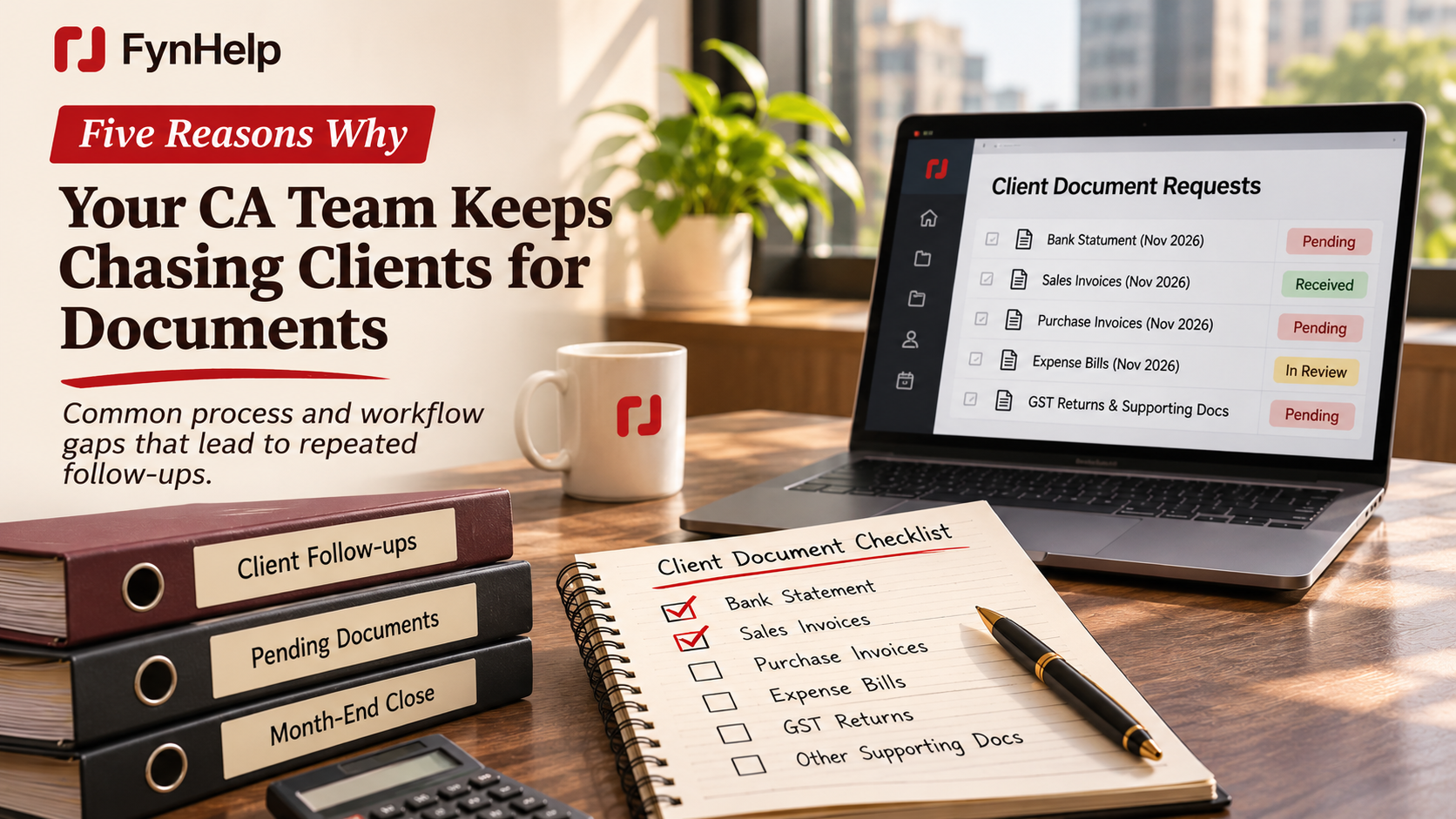
Bank statements: Relevant account and reporting period.
Sales invoices: Required invoices for the period.
Purchase invoices: Supplier bills and supporting details.
Expense bills: Relevant expense documentation.
Supporting schedules: Any additional information required for the engagement.
For every item, record its current status, assigned team member and any notes or clarification required.
For example, a bank statement may be marked as pending, while sales invoices have been received but are awaiting verification. Purchase invoices may require a follow-up, while expense bills are under review.
This is an illustrative checklist. Actual document requirements should be defined according to the client's entity, engagement and accounting work.
The key is to track each request independently instead of relying on a general note that says “documents pending.”
How to improve the document collection workflow
A structured document collection process can follow five stages.
Stage 1: Prepare the request
Identify the client, reporting period and documents required. Use a checklist to avoid vague or incomplete requests.
Stage 2: Send and assign
Send the request through the appropriate communication channel and assign responsibility for monitoring it.
Stage 3: Track responses
Record which documents have arrived, which remain pending and when follow-up is required.
Stage 4: Validate submissions
Check whether the received files are relevant, complete and usable. Request clarification when necessary.
Stage 5: Close the request
Mark the request complete only after the required documents have been received and checked.
This creates a clearer handover from document collection to the next stage of accounting work.
Where FynHelp Chaser fits in
FynHelp is designed to help CA firms organise the client document collection process through its Chaser workflow.
The objective is to make client requests and follow-ups easier to manage, rather than leaving the team to coordinate every pending document through disconnected conversations.
The broader FynHelp workflow connects document collection with subsequent stages:
Chaser: Manages client document requests and follow-ups.
Extract: Processes supported documents and structures information.
Recon: Supports transaction matching and exception management.
Narrate: Supports monthly MIS preparation using processed financial information.
This helps create continuity between collecting client information and using it in the accounting workflow.
FynHelp is designed to work alongside existing accounting systems. Accountants remain responsible for validating submissions, resolving exceptions and reviewing the resulting work.
Explore FynHelp: https://www.fynhelp.com
The question is not how many reminders your team sends
It is whether every request has a clear owner, whether clients know exactly what to submit and whether your team can see what remains pending.
Repeated follow-ups may be a symptom of a process that lacks structure and visibility.
Before asking your team to send another reminder, examine how document requests are created, communicated, tracked and closed.
A better document collection process does not just help you collect files. It helps your team move client work forward with greater clarity.
Explore how FynHelp helps CA firms manage client document collection and connected month-end workflows: https://www.fynhelp.com.