
On this page
- What has ChatGPT introduced for accounting?
- The Indian CA firm's reality is different
- ChatGPT vs FynHelp: Two different areas of focus
- ChatGPT for Accounting
- FynHelp
- The real difference: Accounting tasks vs practice operations
- Scenario A: Using a general accounting AI assistant
- Scenario B: Using a practice workflow platform
- Why Tally and the Indian accounting ecosystem matter
- What should CA firms automate first?
- Repeated client follow-ups
- Document processing
- Bank reconciliation
- MIS preparation
- Work ownership and review
- Does this mean CA firms should choose ChatGPT or FynHelp?
- The bigger question: Will AI replace accountants?
- Where FynHelp is building
- Conclusion: The future is not ChatGPT versus accountants. It is better-connected accounting workflows.
ChatGPT can now help with accounting. But does that mean it understands how an Indian CA firm actually operates?
OpenAI's recent launch of ChatGPT for Accounting is an important development for the accounting industry.
It brings AI assistance closer to everyday accounting work, including invoice processing, suggested account coding, bank reconciliation, month-end reporting and audit preparation.
For accounting professionals, this signals a clear shift: AI is moving beyond answering questions and starting to participate in operational workflows.
But there is another question worth asking.
Does helping with accounting tasks mean managing the operations of a CA practice?
For an Indian Chartered Accountant, the working environment is different from that of a business using a single accounting platform.
A typical CA firm may manage multiple client entities, work across Tally and other accounting systems, handle GST-related records, review 26AS/AIS information, collect documents through WhatsApp and email, coordinate employees and prepare reports for different clients.
And sometimes, the purchase bills arrive on WhatsApp at 11 PM.
This is where the distinction between general-purpose accounting AI and practice-specific workflow intelligence becomes important.
Let's understand the difference.
What has ChatGPT introduced for accounting?
OpenAI's ChatGPT for Accounting combines an accounting-focused plugin with connections to supported accounting applications.
According to OpenAI, it can assist with activities such as:
Preparing draft entries from invoices and receipts.
Suggesting account codes.
Bringing together records for reconciliation and reporting.
Comparing bank statements with general ledger information.
Reviewing month-end workbooks.
Identifying possible duplicates, missing information and unexplained differences.
Preparing draft financial reports for review.
Its listed accounting connections include QuickBooks, Xero, Oracle NetSuite, BILL, FreshBooks, Rillet, Campfire and other supported applications.
The output is intended for human review, and available actions depend on the individual connection and its permissions.
This is a meaningful development. Accountants should understand it, experiment with it and evaluate where it can improve their existing work.
However, there is an important distinction between helping someone complete an accounting task and coordinating the entire operational workflow of a CA firm.
The Indian CA firm's reality is different
Consider how a CA firm actually manages its clients.
A firm may have dozens of active client entities, each with different accounting systems, reporting requirements, document formats and deadlines.
The team might work with:
Tally exports and ledger data.
Bank statements in PDF, Excel and scanned formats.
GST returns and reconciliation records.
Form 26AS and AIS information.
Purchase and sales invoices.
Supporting schedules and expense documents.
Client communication through WhatsApp and email.
Internal spreadsheets used for assignment tracking.
Review comments and pending clarifications.
The challenge is not simply processing one invoice or reconciling one bank statement.
It is coordinating the information, people and workflow across multiple clients.
A document may arrive, but nobody has checked whether the submission is complete.
A transaction may remain unmatched, but the responsible employee has not investigated it.
An assignment may be ready for review, but the partner does not have visibility into its current status.
A client may have sent the required information in a WhatsApp conversation that another employee cannot easily locate.
These are practice-level operational challenges.
And solving them requires more than an accounting assistant.
ChatGPT vs FynHelp: Two different areas of focus
ChatGPT for Accounting and FynHelp should not be viewed as identical products competing to perform the same task.
They approach different parts of the accounting workflow.
ChatGPT brings general-purpose AI capabilities into supported accounting tools and documents.
FynHelp is being built around the operational workflows of Indian CA firms managing multiple client entities.
The distinction is in the workflow context.
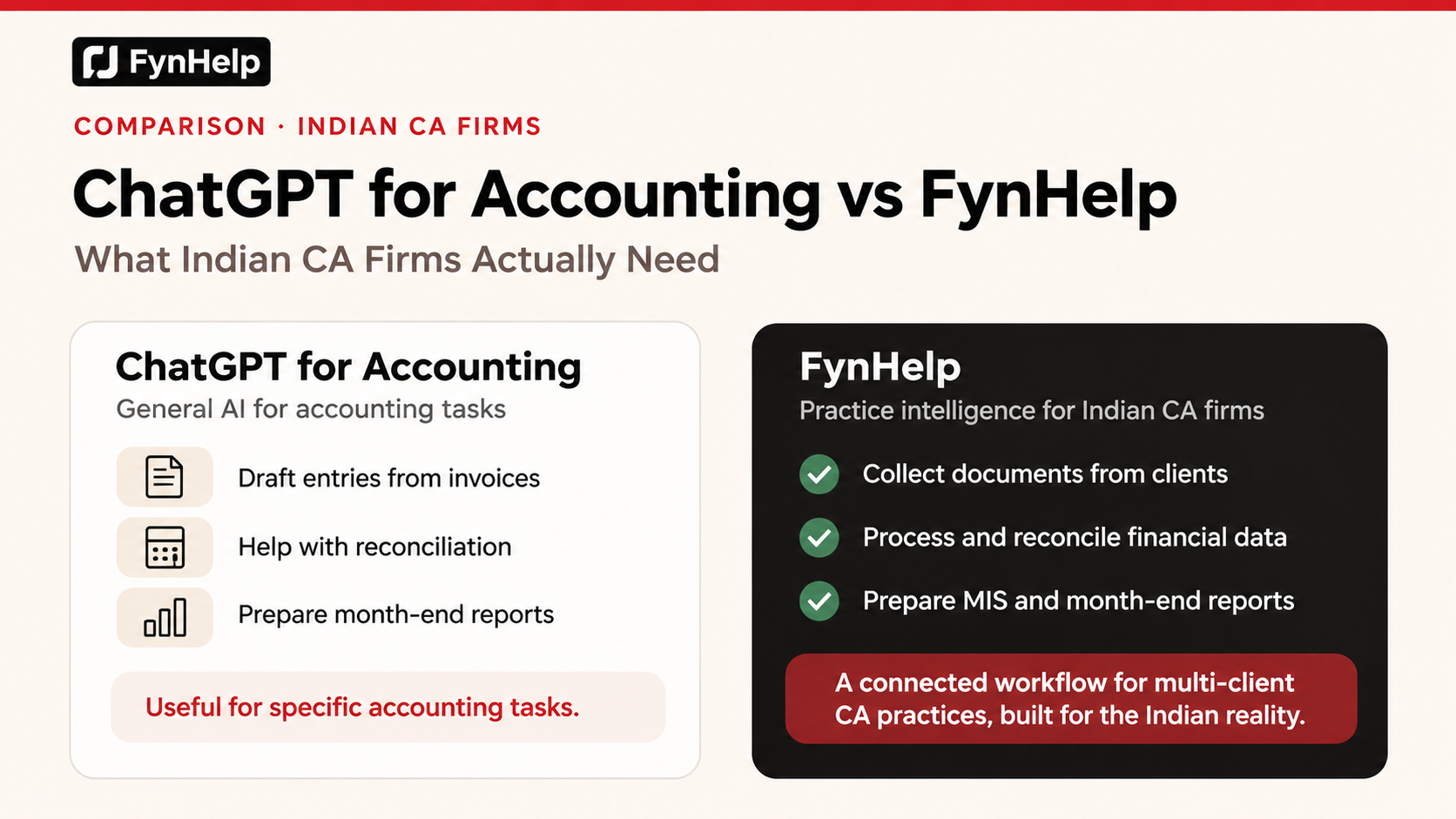
ChatGPT for Accounting
Its focus includes:
Assisting with accounting tasks using supported applications and files.
Drafting invoice entries and suggested account coding.
Supporting bank reconciliation.
Preparing month-end reports.
Reviewing workbooks and supporting records.
It is useful when an accounting professional needs AI assistance with a particular task or connected accounting workflow.
FynHelp
FynHelp focuses on connecting recurring operational activities across a CA firm's client portfolio.
Its workflow is organised around four areas:
Chaser — Client document collection
Client documents are often the starting point of accounting work.
Chaser focuses on structuring document requests, managing follow-ups and improving visibility into missing client information.
Extract — Document intelligence
Financial information arrives in different formats.
Extract focuses on processing supported documents and structuring the information for subsequent accounting workflows, with validation where required.
Recon — Reconciliation and exception management
Reconciliation involves more than matching amounts.
Recon focuses on transaction matching and organising unmatched transactions and exceptions for investigation.
Narrate — MIS preparation
Once financial information has been processed, it needs to be organised into useful reporting.
Narrate supports monthly MIS preparation using processed financial information.
The broader objective is to connect these stages instead of treating every activity as a disconnected task.
FynHelp reads bank statements and Tally exports, matches bank to books, and hands you only the lines that need a decision. Nothing is posted without your approval.
Start free trialFree to start, no card neededThe real difference: Accounting tasks vs practice operations
Consider a practical example.
A CA firm is preparing the month-end accounts for 30 client entities.
For each client, the team needs to collect bank statements, invoices and supporting documents, process the information, reconcile transactions and prepare the required reports.
Now look at the workflow from two perspectives.
Scenario A: Using a general accounting AI assistant
An accountant can use ChatGPT to help process an invoice, examine a bank statement, review a workbook or prepare a report using supported applications and files.
This can assist with individual tasks.
The accountant still needs to coordinate the wider client workflow, identify missing information, manage ownership, track exceptions and ensure the work moves through the firm's review process.
Scenario B: Using a practice workflow platform
A practice workflow platform focuses on organising the work across clients.
The firm needs visibility into:
Which clients have submitted their documents?
Which documents are still pending?
Which files have been processed?
Which transactions remain unmatched?
Which exceptions require investigation?
Who owns each assignment?
Which work is awaiting review?
Which MIS reports are ready for validation?
This is the operational layer that connects the different stages of client work.
The distinction is not that one system can perform accounting and the other cannot.
It is that the primary problem being addressed is different.
Why Tally and the Indian accounting ecosystem matter
One of the biggest considerations for Indian CA firms is the existing technology environment.
Tally remains an important part of many firms' accounting workflows.
Beyond the ledger, professionals also work with GST-related information, Income Tax records, bank statements, supporting documents and client communication channels.
A firm's workflow may look something like this:
Client communication → Document collection → Data extraction → Tally/accounting records → Reconciliation → Exception investigation → MIS preparation → Partner review
The challenge is connecting these activities while preserving the firm's existing accounting processes.
A CA firm does not necessarily want to migrate its ledgers to a new platform just to improve document collection or reconciliation workflows.
This is why FynHelp is positioned as a practice intelligence and month-end close workflow layer alongside existing accounting systems such as Tally and Zoho.
The objective is to improve how work moves around the ledger, not to replace the ledger itself.
Importantly, any specific connector, write-back capability or integration with GST, Income Tax or other portals must be evaluated against what the product currently supports.
What should CA firms automate first?
The biggest opportunity may not be in automating the most complicated accounting activity.
It may be in reducing the coordination required before and after that activity.
Consider five areas.
Repeated client follow-ups
Employees spend time identifying missing documents, checking conversations and sending reminders.
A structured request and follow-up workflow can help make this process more visible.
Document processing
Financial information arrives in different formats.
Supported document extraction and validation can reduce repetitive handling while keeping uncertain information available for review.
Bank reconciliation
Transaction matching is only one part of reconciliation.
Unmatched items, timing differences, split payments and missing references need an organised investigation process.
MIS preparation
Preparing monthly reports requires organised financial information, consistent calculations and explanations that can be verified.
AI can assist with preparation, but the underlying figures and commentary must be reviewed.
Work ownership and review
Managers and partners need to know what is pending, who is responsible and which assignments require attention.
A consolidated workflow can help improve visibility across client entities.
Does this mean CA firms should choose ChatGPT or FynHelp?
Not necessarily.
They can serve complementary purposes.
ChatGPT can be useful for general AI assistance, drafting, analysis and supported accounting workflows.
FynHelp is focused on organising recurring operational work across multiple client entities in a CA practice.
A firm may use general-purpose AI for research, explanations, drafting and analysis while using a practice workflow platform to manage document collection, processing, reconciliation and reporting activities.
The decision should depend on the problem the firm wants to solve.
If the requirement is to analyse a workbook or prepare a draft report, an accounting AI assistant may be useful.
If the requirement is to improve visibility into client document requests, ownership, reconciliation exceptions and month-end workflow across multiple entities, a practice-specific platform becomes relevant.
The two should be evaluated on their actual capabilities, integrations, data controls and operating requirements rather than marketing claims.
The bigger question: Will AI replace accountants?
The accounting profession will change.
Repetitive activities such as data entry, document processing, initial matching and report preparation are increasingly suitable for AI-assisted workflows.
But accounting is not simply the movement of numbers from one place to another.
A CA must understand the context behind those numbers.
Why is a transaction unmatched?
Is a particular expense correctly classified?
Does a difference have a tax implication?
Is the supporting evidence sufficient?
What should be communicated to the client?
Does the final output meet the firm's review requirements?
These questions require professional knowledge, interpretation and accountability.
AI may reduce the time spent on repetitive work, but it does not automatically assume the professional responsibility of the accountant.
The more important question is how CA firms can use AI to give their teams more time for verification, advisory and client service.
Where FynHelp is building
At FynHelp, we believe the next important shift in accounting technology is not just making AI better at answering accounting questions.
It is making the operational workflow of a CA firm more connected.
We are building FynHelp around the recurring work that happens across multiple client entities:
Collecting documents from clients.
Processing financial information.
Reconciling transactions.
Organising exceptions.
Preparing monthly MIS.
Improving visibility into pending work.
Our approach is to work alongside existing accounting systems and help firms organise the activities surrounding their ledgers.
Because the problem is not always the accounting software.
Sometimes, it is everything that happens before the accounting work can begin and everything that happens before the work can be signed off.
That is the problem FynHelp is focused on solving.
Explore FynHelp: https://www.fynhelp.com
Conclusion: The future is not ChatGPT versus accountants. It is better-connected accounting workflows.
OpenAI's accounting launch is a strong signal that AI is becoming part of everyday accounting work.
CA firms should pay attention to it.
They should experiment, understand its limitations and identify where it can help their teams.
But Indian CA firms also need to examine their own operating environment.
Multiple clients. Multiple document formats. Tally and other ledgers. GST and tax records. WhatsApp follow-ups. Reconciliation exceptions. Employee coordination. Partner reviews.
The next opportunity is to connect these activities into a more structured workflow.
ChatGPT can help with accounting tasks. FynHelp is focused on the operational workflows that connect those tasks across a CA practice.
The question for CA firms is no longer whether AI will enter accounting.
It is whether their workflows are ready for it.
Explore FynHelp: https://www.fynhelp.com