
On this page
- Incomplete or inconsistent transaction data
- Timing differences between bank and book entries
- Split payments and one-to-many transaction relationships
- Weak or missing transaction references
- Unresolved exceptions have no clear owner
- How to make reconciliation delays more visible
- Where FynHelp Recon fits in
- A checklist to identify why your reconciliation is delayed
- Faster reconciliation starts with understanding the delays
Bank reconciliation is a routine accounting activity. Yet, for many accounting teams, it can take considerably longer than anticipated.
The immediate assumption is often that there are too many transactions to process.
But transaction volume is only one part of the problem.
Even a manageable set of bank transactions can take hours to reconcile when information is incomplete, payment references are unclear or exceptions require repeated investigation.
For CA firms managing multiple client accounts, these delays can affect the wider month-end workflow.
So, what actually makes bank reconciliation take longer than expected?
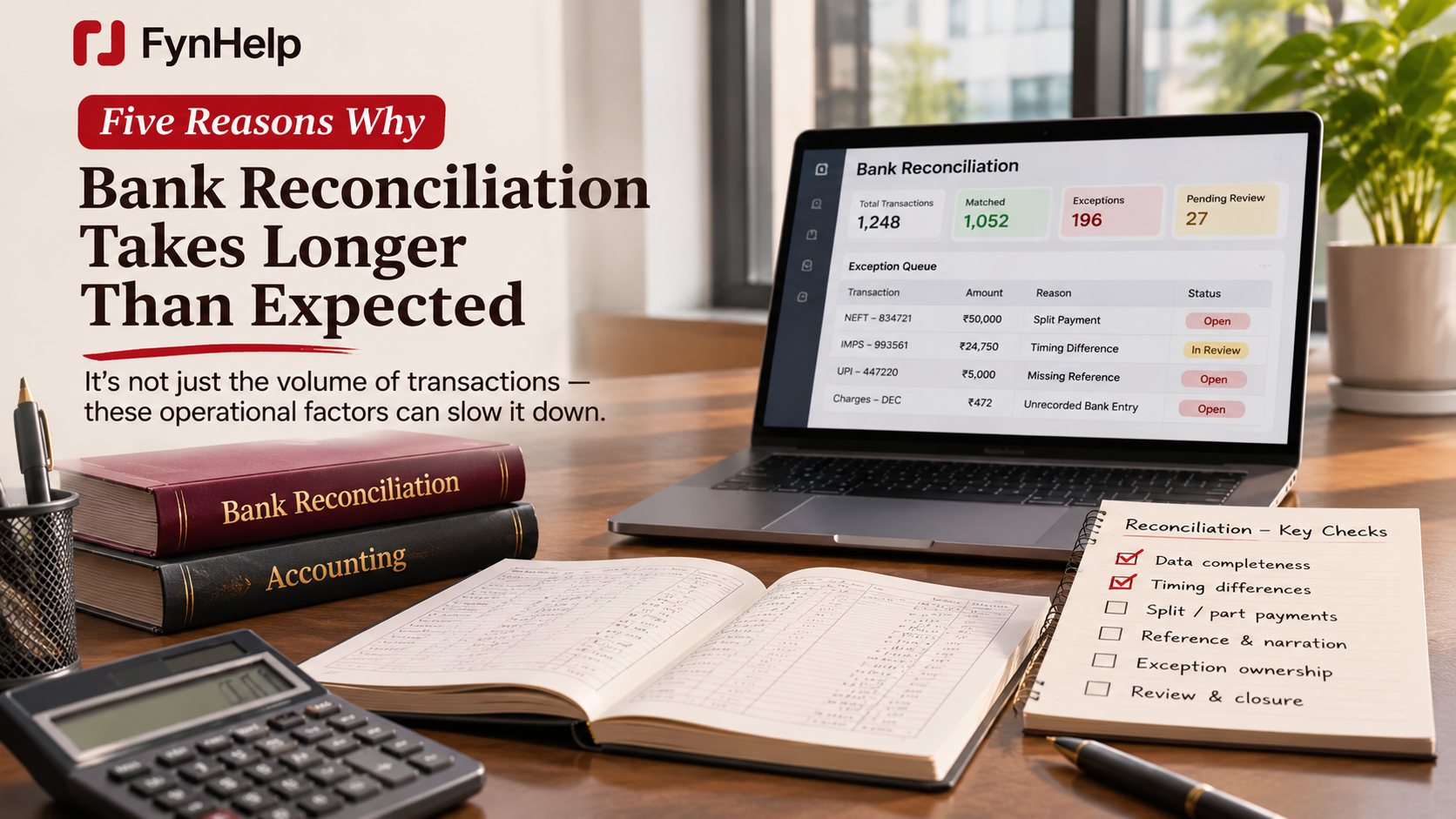
Here are five operational reasons worth examining.
Incomplete or inconsistent transaction data
Reconciliation depends on having usable information from both the bank statement and the accounting records.
However, the data may not always be complete or consistent.
For example:
A bank statement may contain abbreviated transaction descriptions.
A ledger export may have missing narrations.
Transaction dates may use different formats.
Some records may be duplicated or missing.
Imported files may contain inconsistent columns or values.
When the information is not ready for comparison, accountants must spend additional time checking and correcting the underlying data.
What can help?
Standardise the data before matching begins. Check that transaction dates, amounts, descriptions and references are available and consistently structured.
Timing differences between bank and book entries
Not every transaction appears in the bank statement and accounting records on the same date.
Consider a fictional example:
A business records a payment of ₹42,000 on 31 December. The corresponding bank debit appears on 2 January.
The accountant may initially see an unmatched entry when comparing the two records for December.
This does not automatically indicate an error. It may be a timing difference that requires investigation.
Other examples include:
Cheques issued but not yet presented.
Deposits recorded before bank credit.
Transactions processed by the bank after the accounting entry.
Delays between payment initiation and settlement.
What can help?
Track the relevant transaction dates and identify timing-related exceptions separately. This helps accountants distinguish outstanding transactions from actual discrepancies.
Split payments and one-to-many transaction relationships
A direct one-to-one match is not always possible.
Consider a fictional example:
A customer has an outstanding invoice of ₹60,000 but makes two separate payments:
₹35,000 on 5 January.
₹25,000 on 8 January.
The books contain one invoice for ₹60,000, while the bank statement contains two credits.
A simple amount-by-amount comparison may not identify the relationship.
The opposite situation can also occur: one bank payment may settle several invoices.
What can help?
Support investigation of one-to-many and many-to-one relationships. Accountants should verify the payment allocation and outstanding balances before confirming the reconciliation.
FynHelp reads bank statements and Tally exports, matches bank to books, and hands you only the lines that need a decision. Nothing is posted without your approval.
Start free trialFree to start, no card neededWeak or missing transaction references
Transaction references are useful for identifying the purpose and source of a payment.
But real bank statements may contain abbreviated descriptions, incomplete references or generic narrations.
For example:
Bank statement Accounting record
NEFT-XX4582 – ₹28,000 Customer receipt – ABC Traders – ₹28,000
UPI-XXXX – ₹12,500 Vendor payment – XYZ Services – ₹12,500
IMPS-XXXX – ₹8,000 Customer advance – ₹8,000
The amounts may be identical, but the descriptions do not provide enough information to confirm the relationship independently.
What can help?
Use available context such as transaction dates, customer or vendor ledgers, payment references and supporting documents. Similar amounts should be treated as potential matches until the relationship is adequately verified.
Unresolved exceptions have no clear owner
This is an operational issue that can extend reconciliation time even after most transactions have been matched.
Consider a reconciliation containing 500 transactions, of which 470 have been matched and 30 remain unresolved.
The remaining transactions may include:
Missing accounting entries.
Duplicate-looking transactions.
Amount mismatches.
Unidentified receipts.
Timing differences.
Transactions requiring client clarification.
If these exceptions are simply left in an unmatched list, the team may struggle to determine who should investigate them and what action is required.
What can help?
Create an exception queue with clear ownership and status tracking. Each unresolved item should have an assigned person, a reason for the exception, relevant supporting information and a next action.
How to make reconciliation delays more visible
A structured reconciliation workflow should make it possible to understand not just how many transactions are unmatched, but why they remain unresolved.
A useful exception queue can capture:
Client and entity.
Bank account.
Transaction date and amount.
Bank statement description.
Related book entry, if identified.
Exception category and reason.
Assigned team member.
Supporting documents or investigation notes.
Current status.
Reviewer comments and resolution history.
This makes it easier for accountants and managers to identify bottlenecks instead of repeatedly reviewing the same unmatched transactions.
Where FynHelp Recon fits in
FynHelp's Recon workflow is designed to support transaction matching and exception management for CA firms.
The workflow focuses on:
Transaction processing: Preparing supported transaction data for reconciliation.
Matching: Applying deterministic matching logic to identify potential relationships between bank and book entries.
Exception identification: Separating matched transactions from items that need further investigation.
Exception management: Organising unresolved items so the accounting team can investigate and review them.
The objective is to reduce repetitive matching effort and improve visibility into unresolved transactions.
It does not mean every transaction can be automatically reconciled. Split payments, timing differences, missing references and other exceptions may still require supporting evidence, accountant judgement and review.
FynHelp is designed to work alongside existing accounting systems rather than replace the firm's ledger.
Explore FynHelp: https://www.fynhelp.com
A checklist to identify why your reconciliation is delayed
Before assuming transaction volume is the problem, review these questions:
Are bank statements and book exports complete and consistently structured?
Are timing differences identified separately?
Can the process identify split payments and related transactions?
Are weak or missing references flagged for investigation?
Does every unresolved exception have a reason and an owner?
Can accountants see which items are waiting for client clarification?
Can reviewers identify unresolved items without repeating the entire reconciliation?
The answers can help identify whether delays are caused by data quality, transaction complexity or the way exceptions are managed.
Faster reconciliation starts with understanding the delays
Reconciliation time is influenced by more than the number of transactions being processed.
Incomplete information, timing differences, split payments, unclear references and unresolved exceptions can all create additional work.
For CA firms, the goal should not simply be to match transactions faster. It should be to make the entire process easier to understand, investigate and review.
When every unmatched transaction has a reason, an owner and a next action, reconciliation becomes a more structured process.
Explore how FynHelp supports transaction matching and exception management: https://www.fynhelp.com.