
On this page
- Why Managing Multiple Clients Becomes Difficult
- Managing Clients Through Spreadsheets: What Works and What Becomes Difficult?
- A. Multiple trackers create fragmented visibility
- B. Updates depend on manual maintenance
- C. Ownership becomes harder to identify
- D. Partners need to ask for updates
- E. Tracking exceptions requires additional coordination
- Managing 30 Clients: Spreadsheet-Based vs. Centralised Workflow
- What Should a Centralised CA Practice Workflow Show?
- What is happening with each client?
- What information is still missing?
- Who is responsible for the next action?
- Where is the work getting stuck?
- What requires the partner's attention?
- How FynHelp Helps Connect Multiple Client Workflows
- Client and Entity Management
- Chaser: Document Collection
- Extract: Financial Data Processing
- Recon: Reconciliation Management
- Narrate: Monthly MIS Preparation
- When Should a CA Firm Consider Moving Beyond Spreadsheets?
- Questions to Ask Before Choosing Practice Workflow Software
- Conclusion: More Clients Should Not Mean More Coordination
- Explore FynHelp
Managing five clients and managing thirty clients are two very different operational challenges.
When a CA firm has a smaller client base, maintaining updates through spreadsheets, WhatsApp messages and individual follow-ups may work reasonably well.
The team knows its clients. Partners know what is pending. Employees can often remember which documents have arrived and which assignments need attention.
But as the number of clients increases, keeping track of everything becomes more complicated.
A document is pending with one client. A reconciliation is awaiting review for another. A team member is waiting for clarification, while a partner needs an update on three other assignments.
Suddenly, the challenge is no longer just completing accounting work.
It is knowing what is happening across every client, every team member and every ongoing assignment.
This raises an important question:
Can a spreadsheet-based workflow provide enough visibility when a CA firm starts managing multiple clients at scale?
Let's look at the difference.
Why Managing Multiple Clients Becomes Difficult
Every client engagement involves several activities.
Depending on the services provided, a CA firm may need to manage:
Client information and entity details.
Bank statements and financial documents.
Purchase and sales records.
Accounting data and reconciliation.
GST and other compliance-related information.
Monthly reporting and working papers.
Internal reviews and pending clarifications.
Now multiply these activities across 30 clients.
Not every client submits information at the same time. Some require repeated follow-ups. Some assignments are ready for review, while others are waiting for documents or clarification.
The team must continuously answer questions such as:
Which clients have submitted all the required documents?
Which clients are still pending?
Who is responsible for each assignment?
Which reconciliations are incomplete?
Which files are waiting for senior review?
What needs attention today?
Individually, these questions seem straightforward.
Collectively, they create a significant coordination responsibility.
Managing Clients Through Spreadsheets: What Works and What Becomes Difficult?
Spreadsheets are useful tools for accounting practices.
They are flexible, familiar and easy to customise. Firms can create client lists, document checklists, task trackers and deadline calendars without introducing additional software.
For smaller workflows, this approach can be perfectly practical.
However, challenges can emerge when multiple employees maintain different trackers or when information needs to be updated across several files.
A. Multiple trackers create fragmented visibility
One employee may maintain a document collection tracker, another may manage reconciliation status, and a senior may maintain a separate review sheet.
Each tracker may contain useful information.
But getting a complete picture of one client's progress can require checking multiple sources.
B. Updates depend on manual maintenance
When a document arrives or an assignment moves to the next stage, someone needs to update the relevant tracker.
If the update is missed, the information may no longer reflect the actual status of the work.
C. Ownership becomes harder to identify
When several employees work on different clients, it becomes important to know who is responsible for each task.
Without clear ownership, pending work can require additional internal follow-ups.
D. Partners need to ask for updates
Partners should be able to understand the status of client work without repeatedly asking individual team members.
When information is distributed across separate trackers, getting that visibility can become time-consuming.
E. Tracking exceptions requires additional coordination
A reconciliation may be incomplete because of missing information, an unmatched transaction or a pending clarification.
Simply marking the assignment as pending does not always explain what needs to happen next.
The underlying reason and responsibility need to be visible.
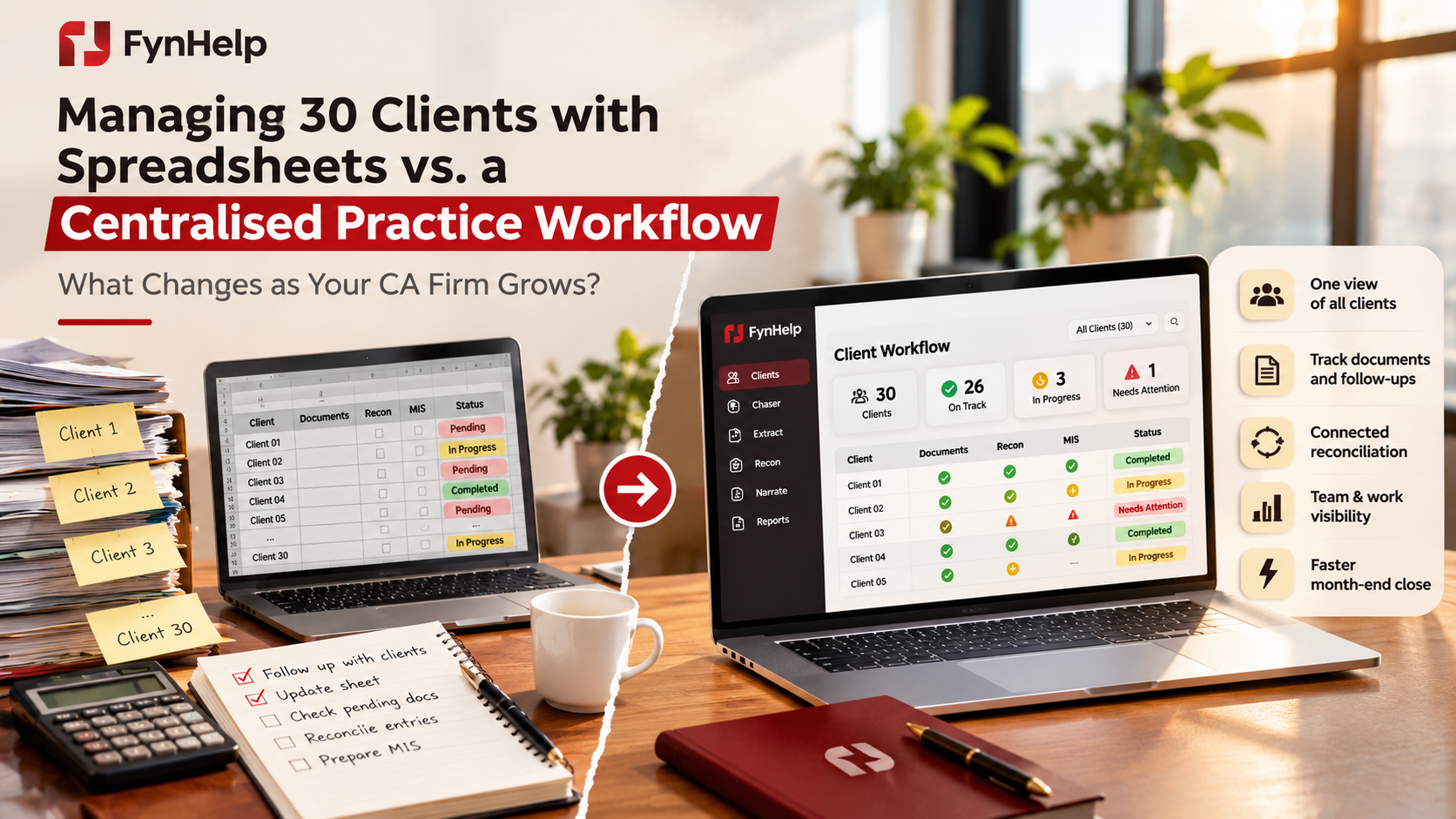
Managing 30 Clients: Spreadsheet-Based vs. Centralised Workflow
The objective is not to eliminate spreadsheets simply because they are spreadsheets.
The objective is to understand when the process needs more connected visibility.
Operational area Spreadsheet-based approach Centralised practice workflow Client information Maintained in separate sheets or files Organised client and entity records Document collection Requests and receipt tracked manually Requests and document status managed together Team ownership Updated through individual trackers Work ownership visible within the workflow Reconciliation Status maintained separately Matching and exceptions connected to the workflow Pending tasks Employees check different trackers Pending work visible centrally Review process Status updated manually Review stages and outstanding work can be tracked Partner visibility Requires updates from team members Centralised view of client work progress
A centralised workflow does not automatically solve every operational problem.
Its value comes from making important information easier to access, update and act upon.
FynHelp reads bank statements and Tally exports, matches bank to books, and hands you only the lines that need a decision. Nothing is posted without your approval.
Start free trialFree to start, no card neededWhat Should a Centralised CA Practice Workflow Show?
If a CA firm is managing multiple client entities, its workflow should provide visibility beyond just a client name and an assignment deadline.
A useful centralised view should answer five important questions.
What is happening with each client?
Partners and managers should be able to understand the current status of every client engagement.
For example:
Documents requested.
Documents received.
Data processing in progress.
Reconciliation pending.
Review in progress.
Reporting completed.
What information is still missing?
The team should be able to identify which documents or details are outstanding instead of searching through conversations and individual folders.
Who is responsible for the next action?
Every pending activity should have clear ownership.
This helps reduce confusion about who needs to follow up, investigate an exception or complete a review.
Where is the work getting stuck?
A useful workflow should make bottlenecks visible.
For example, an assignment may be delayed because the client has not submitted a bank statement, because transactions remain unmatched or because the file is awaiting review.
Understanding the reason is more useful than simply knowing that something is pending.
What requires the partner's attention?
Partners should be able to distinguish routine activities from matters requiring review, intervention or a client discussion.
This makes it easier to prioritise work across multiple engagements.
How FynHelp Helps Connect Multiple Client Workflows
This is one of the operational problems we are working to address at FynHelp.
FynHelp is a practice intelligence and month-end close workflow platform designed for Indian CA firms and accounting practices managing multiple client entities.
The idea is to connect important stages of client accounting instead of managing every activity independently.
Client and Entity Management
Organise client and entity information so that the firm has a structured foundation for managing multiple engagements.
Chaser: Document Collection
Manage client document requests and follow-ups, helping teams track what has been requested and received.
Extract: Financial Data Processing
Extract and structure information from supported financial documents so that it can move into subsequent accounting workflows.
Recon: Reconciliation Management
Identify transaction matches and bring unmatched items into an exception workflow for further investigation.
Narrate: Monthly MIS Preparation
Support monthly MIS preparation using processed financial information, with source traceability to help the team review the underlying data.
Together, these workflows are designed to make the journey from collecting client information to preparing monthly reports more connected.
The intention is not to replace the accounting systems a CA firm already uses.
It is to improve the operational workflow around them.
When Should a CA Firm Consider Moving Beyond Spreadsheets?
There is no universal client-count threshold at which spreadsheets stop working.
The right time depends on the complexity of the firm's operations, the number of team members involved and the amount of coordination required.
However, certain signs indicate that the existing process may need improvement:
Employees regularly ask each other for client status updates.
Partners depend on manual reports to understand pending work.
Multiple spreadsheets track different stages of the same assignment.
Client document follow-ups are difficult to monitor.
Work ownership is unclear.
Reconciliation exceptions are tracked separately.
The team spends considerable time updating trackers instead of progressing assignments.
If these situations are becoming familiar, it may be time to evaluate a more connected workflow.
Questions to Ask Before Choosing Practice Workflow Software
Before introducing a new platform, CA firm partners should evaluate whether it addresses their actual operational requirements.
Consider asking:
Can the platform manage multiple clients and entities in one place?
Can team members access information according to their responsibilities?
Can client document requests and pending items be tracked?
Does it support the financial document formats used by the firm?
Can reconciliation matches and exceptions be reviewed?
Can the team understand the status of each client engagement?
Can monthly MIS preparation be connected to the underlying financial information?
Can it work alongside the accounting systems the firm already uses?
Are data access, permissions and audit trails available?
Can the team adopt the platform without disrupting its existing processes?
The most important thing is to evaluate the complete workflow, not just the number of features a software product offers.
Conclusion: More Clients Should Not Mean More Coordination
Spreadsheets have an important place in accounting practices. They are flexible, familiar and useful for many day-to-day activities.
But as a CA firm grows, managing multiple clients through disconnected trackers can make it harder to maintain visibility into documents, assignments, reconciliation and review.
The next stage of practice management is not necessarily about adding more tools.
It is about connecting the workflows that already exist.
When client information, document collection, financial data processing, reconciliation and reporting work together, teams have a clearer view of what is happening and what needs attention.
At FynHelp, we are building towards this vision.
The goal is simple: help CA firms manage more client work without allowing operational coordination to become the bottleneck.
Explore FynHelp
Managing multiple clients? See how FynHelp brings document collection, data extraction, reconciliation and monthly MIS preparation into a connected workflow.
Visit https://www.fynhelp.com to explore what we're building for CA firms.
If you run an accounting practice, we'd also like to understand how your team currently tracks work across clients. Your experience can help shape the next generation of practice workflows.