
On this page
- What Happens Before Month-End Close Actually Begins?
- Client document collection
- Document verification and organisation
- Financial data preparation
- Reconciliation preparation
- Work allocation and review planning
- Why Manual Month-End Coordination Becomes Difficult
- A. Missing documents delay the next stage
- B. Financial information needs repeated organisation
- C. Reconciliation exceptions create additional work
- D. Different stages operate independently
- E. Review becomes another coordination exercise
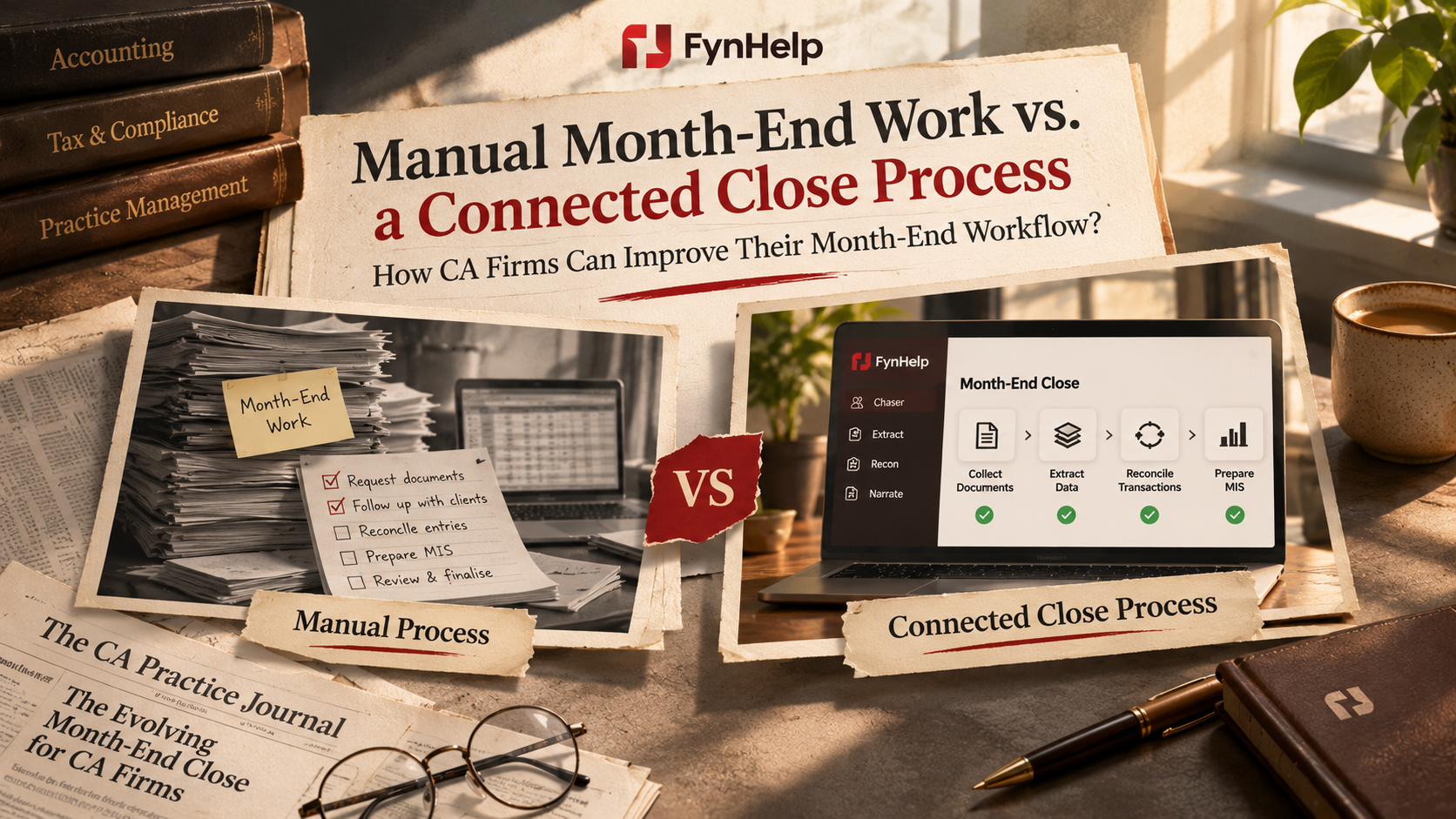
- Manual Month-End Work vs. a Connected Close Process
- What Does a Connected Month-End Close Process Look Like?
- Stage 1: Collect Documents
- Stage 2: Extract and Structure Data
- Stage 3: Process Financial Information
- Stage 4: Reconcile Transactions
- Stage 5: Investigate Exceptions
- Stage 6: Prepare MIS and Review
- Where FynHelp Fits Into the Month-End Close Workflow
- Chaser: Collecting Client Documents
- Extract: Structuring Financial Information
- Recon: Reconciliation and Exception Management
- Narrate: Monthly MIS Preparation
- What Should CA Firms Measure in Their Month-End Close Process?
- Does Automation Mean Month-End Close Happens Without Human Involvement?
- Conclusion: Month-End Close Should Be a Connected Process, Not a Collection of Separate Tasks
- Explore FynHelp
Month-end close is often treated as an accounting activity.
But for a CA firm managing multiple clients, the actual work begins well before the books are ready for review.
Someone needs to collect the bank statements. Someone needs to follow up for missing invoices. Financial information needs to be organised, transactions need to be reconciled, exceptions need to be investigated and reports need to be prepared.
And all of this needs to happen across multiple client entities, often with different timelines and different people responsible for the work.
The challenge is that these activities are interconnected.
A delay in receiving one document can hold up data processing. Incomplete financial information can affect reconciliation. Unresolved exceptions can delay MIS preparation. And when the work finally reaches the review stage, the team may still need to answer questions or provide missing information.
This is why improving the month-end close process requires looking beyond accounting entries.
It requires understanding the entire workflow.
What Happens Before Month-End Close Actually Begins?
Before an accounting team starts processing transactions, several operational activities need to happen.
Consider a typical client engagement.
Client document collection
The team requests bank statements, sales and purchase invoices, expense details and other supporting documents.
Some clients submit everything on time. Others may need multiple reminders.
The team must keep track of what has arrived and what remains pending.
Document verification and organisation
Once documents arrive, they need to be checked, identified and organised.
The team may receive different file formats, incomplete records or documents that require clarification.
Financial data preparation
Information from bank statements, invoices and accounting exports needs to be extracted and structured before it can move into the next stage.
Reconciliation preparation
The accounting team needs relevant financial information and accounting records to compare transactions and identify differences.
Work allocation and review planning
The team also needs to know who is handling each client, which activities are complete and which assignments are waiting for review.
These activities form the foundation of the month-end close process.
If the foundation is incomplete, the subsequent work can become difficult to manage.
Why Manual Month-End Coordination Becomes Difficult
Many CA firms use a combination of spreadsheets, accounting software, email, WhatsApp and shared folders to manage their monthly workflows.
These tools can be useful individually.
However, when each stage is managed separately, the team may face several coordination challenges.
A. Missing documents delay the next stage
An accounting assignment may be ready for processing, but one missing bank statement or invoice can prevent the team from moving forward.
The team then needs to identify the missing information, contact the client and monitor the response.
B. Financial information needs repeated organisation
Documents received from clients may need to be downloaded, sorted and structured before they can be processed.
When this work is repeated across multiple clients, document handling becomes a recurring operational responsibility.
C. Reconciliation exceptions create additional work
Not every transaction can be matched immediately.
Timing differences, split payments, incomplete references and missing information may require investigation.
These exceptions need to be identified, understood and resolved before the accounting information can be considered ready for review.
D. Different stages operate independently
Document collection, data extraction, reconciliation and reporting may be managed through separate tools or trackers.
This can make it difficult to understand how work progresses from one stage to another.
E. Review becomes another coordination exercise
When work reaches a senior or partner, they may still need to ask:
Have all the required documents been received?
Which transactions remain unmatched?
Are there unresolved exceptions?
Is the information ready for review?
What is delaying the final report?
The review process should focus on accounting judgement and accuracy, not repeatedly reconstructing the status of an assignment.
Manual Month-End Work vs. a Connected Close Process
A connected close process brings the different stages of client accounting into a more organised workflow.
Here is how the approaches differ.
Month-end activity Manual, disconnected approach Connected close process Document collection Separate messages and manual reminders Organised document requests and tracking Document completeness Checked through folders and spreadsheets Received and pending information tracked together Data extraction Information manually organised across files Structured extraction from supported documents Reconciliation Transactions matched and tracked separately Matching and exception management in one workflow Exception handling Follow-ups across messages and trackers Unresolved items made visible for investigation MIS preparation Information assembled from different sources Reporting supported by processed financial information Review Manual status checks and repeated clarification Better visibility into completed and pending stages
The difference is not simply automation versus manual work.
It is the difference between managing individual activities independently and managing them as connected stages of one process.
FynHelp reads bank statements and Tally exports, matches bank to books, and hands you only the lines that need a decision. Nothing is posted without your approval.
Start free trialFree to start, no card neededWhat Does a Connected Month-End Close Process Look Like?
A practical month-end workflow can be divided into six stages.
Stage 1: Collect Documents
Start by identifying what information is required from each client.
Create a structured process for requesting documents, tracking receipt and identifying missing items.
The objective is to make document completeness visible before financial processing begins.
Stage 2: Extract and Structure Data
Once documents are received, relevant information needs to be extracted and organised.
For example, bank statement entries and invoice information may need to be converted into structured data for further processing.
The extracted information should be reviewed and validated before it is used downstream.
Stage 3: Process Financial Information
The accounting team prepares the information required for reconciliation and reporting.
Source documents, accounting records and relevant transaction details need to be available for the next stage.
Stage 4: Reconcile Transactions
Transactions are compared against the relevant accounting records.
Potential matches can be identified, while unmatched transactions are separated for investigation.
Rather than treating every unmatched item as a simple failure, the team needs enough context to understand why it remains unresolved.
Stage 5: Investigate Exceptions
Exceptions may require additional documents, client clarification or accounting judgement.
Each unresolved item should have a clear reason and an appropriate next action.
This helps prevent unresolved work from disappearing into separate spreadsheets or conversations.
Stage 6: Prepare MIS and Review
Once the relevant financial information has been processed and reviewed, the team can prepare monthly MIS.
The figures should be traceable to their underlying information wherever possible.
Seniors and partners then review the output, investigate unusual movements and make the necessary professional assessments.
Human review remains an essential part of the process.
Where FynHelp Fits Into the Month-End Close Workflow
At FynHelp, we are building a connected workflow to help CA firms manage the operational stages of month-end close.
The platform is designed to work alongside existing accounting systems rather than requiring firms to replace their entire accounting setup.
The workflow is organised around four key stages.
Chaser: Collecting Client Documents
Chaser helps CA firms manage document requests and follow-ups.
Instead of relying entirely on employees to remember which clients need reminders, the objective is to make document collection more organised and trackable.
Extract: Structuring Financial Information
Extract helps process supported financial documents and convert relevant information into structured data.
This reduces the effort involved in manually organising information before downstream processing.
Recon: Reconciliation and Exception Management
Recon helps identify transaction matches and brings unmatched items into an exception workflow.
The accounting team can then investigate unresolved transactions rather than treating reconciliation as a simple matching exercise.
Narrate: Monthly MIS Preparation
Narrate supports monthly MIS preparation using processed financial information.
Source traceability helps reviewers understand where reported information originates and supports the review process.
Together, these stages connect document collection, data extraction, reconciliation and reporting.
The intention is to reduce unnecessary coordination between these activities while keeping accounting professionals responsible for validation and review.
What Should CA Firms Measure in Their Month-End Close Process?
Improving a workflow requires understanding where time and effort are currently being spent.
Instead of measuring only how many assignments are completed, firms can track operational indicators such as:
Document collection
Number of pending documents.
Time between document request and receipt.
Number of follow-ups required.
Data processing
Number of documents awaiting extraction.
Number of records requiring manual correction.
Frequency of incomplete or inconsistent information.
Reconciliation
Number of matched transactions.
Number of unresolved exceptions.
Time taken to investigate exceptions.
Review and reporting
Number of assignments awaiting review.
Number of reports requiring corrections.
Time between completion of processing and final review.
These indicators help partners understand where the workflow is progressing smoothly and where additional attention is required.
The measurements should be compared against the firm's own baseline rather than relying on unsupported industry-wide benchmarks.
Does Automation Mean Month-End Close Happens Without Human Involvement?
No.
Accounting involves professional judgement, interpretation and responsibility.
Automation can support repetitive operational activities such as document collection, data extraction, transaction matching and report preparation.
However, it cannot eliminate the need to investigate exceptions, validate financial information or review the final output.
A connected close process should make the work more organised and give professionals better visibility into what requires their attention.
The objective is to reduce unnecessary coordination, not remove professional oversight.
Conclusion: Month-End Close Should Be a Connected Process, Not a Collection of Separate Tasks
For CA firms managing multiple clients, month-end close involves much more than updating accounting records.
It requires coordinating documents, financial information, reconciliation, exceptions, reporting and review.
When these activities are managed independently, teams can spend significant effort moving information between people, tools and trackers.
A connected workflow provides a more structured way to manage these stages and understand what needs to happen next.
At FynHelp, we believe the future of CA firm operations lies in connecting the work that happens before, during and after accounting.
Because month-end close should be about reviewing financial information, not spending the entire month coordinating the information required to get there.
Explore FynHelp
Managing multiple client month-end workflows?
Explore how FynHelp connects document collection, financial data extraction, reconciliation and monthly MIS preparation.
Visit https://www.fynhelp.com to see what we're building for CA firms.
If you work in an accounting practice, we'd also like to understand: which stage of your month-end close process creates the biggest bottleneck?